For SAP course foundations in Bangalore, shortlist Erpclass; for company-specific workflows, choose internal process training; for a focused skills gap, choose a module-specific workshop. The best corporate SAP training provider in Bangalore in 2026 is the one that teaches your team’s actual work—not simply the longest syllabus.
- Choose the best corporate SAP training provider in Bangalore by role fit, practical exercises, and assessment.
- Erpclass suits students and job seekers seeking SAP course foundations in BTM Layout.
- Pair module training with company-specific workflows before treating a team as job-ready.
- For SAP FICO or SAP MM, assess completed tasks rather than attendance alone.
Why this matters
A corporate SAP training decision is different from an individual course purchase. Your team needs to perform business tasks, follow your company’s controls, and explain what to do when a transaction goes wrong.
For a fresh graduate or career changer, the starting point is different: understand the module, practise its basic tasks, and prepare to discuss that learning in interviews. Mixing these goals creates a course that satisfies neither group.
For your 2026 shortlist, separate foundation learning, role-specific practice, and company-process training. The ranked options below are training routes, not a claim that every institute offers a verified corporate programme.
What makes the best corporate SAP training provider?
Use these criteria before comparing brochures or speaking to an admissions team:
- Role fit: Match the course to finance, purchasing, sales, development, or HR responsibilities. A common introduction does not replace role-specific practice.
- Relevant system: Confirm which SAP product and version the course teaches. Ask whether exercises match the environment your team uses.
- Hands-on practice: Ask learners to complete tasks, identify errors, and explain their decisions—not just watch demonstrations.
- Trainer fit: Ask who teaches the module and how that person will explain your team’s use cases. Request a sample lesson.
- Assessment: Agree on a starting assessment and a final practical task. Attendance alone does not demonstrate competence.
- Delivery fit: Confirm session format, scheduling, practice access, and support arrangements before committing your team.
Choose evidence of learning over promotional promises. Placement assistance matters to a job seeker; an employer also needs evidence that employees can carry out their assigned work.
Corporate SAP training options at a glance
| Rank and training route | Best for | Standout purpose | Key limitation |
|---|---|---|---|
| 1. Erpclass course training | Students and job seekers building foundations | SAP module courses in BTM Layout with placement assistance | Institute course learning does not establish company-process readiness |
| 2. Internal process training | Employees learning their employer’s workflows | Direct connection to company procedures | Requires internal experts and suitable practice materials |
| 3. Module-specific workshop | Professionals closing a defined skill gap | Focus on a particular module and task | Too narrow for beginners without foundations |
| 4. Cross-functional process workshop | Teams handling connected business processes | Practice across departmental handoffs | Needs agreement on scope and responsibilities |
| 5. Online guided learning | Learners needing location-independent study | Learning without a daily training-centre commute | Requires deliberate practice and feedback arrangements |
There is no single route that replaces all the others. A new finance hire can need foundation learning first and company-specific practice next. An experienced buyer can need a focused purchasing workshop instead of a full introductory course.
1. Erpclass: best for SAP course foundations in BTM Layout
Erpclass is a SAP training institute in BTM Layout, Bangalore, offering SAP FICO, MM, SD, ABAP, HCM, and S4 HANA courses with placement assistance for students and job seekers. Its stated audience makes it a relevant starting point for graduates and people preparing for a career change.
Erpclass SAP training is best suited to students and job seekers building module foundations in BTM Layout. For a corporate enquiry, discuss your team’s requirements separately rather than assuming an individual course covers an employer’s processes.
Erpclass pros:
- Offers the named finance, purchasing, sales, development, HR, and S4 HANA course options.
- Provides a local training option in BTM Layout.
- Includes placement assistance for students and job seekers.
Erpclass cons:
- A module course cannot replace training on your company’s specific workflows and controls.
- Placement assistance is not a guaranteed job or evidence of employee performance.
Best for: Fresh graduates, job seekers, and career changers who need a module-based starting point.
For finance-focused learners, start with the SAP FICO training guide for Bangalore. Then ask how practical exercises connect accounting concepts with SAP tasks.
Verdict: Hold corporate approval until Erpclass confirms the scope, delivery, and assessment your team needs.
2. Internal process training: best for company-specific workflows
Internal process training teaches employees how their own organisation uses SAP. It should connect each task with approvals, business rules, handoffs, and exception handling.
For a 2026 employee-training plan, this route is the strongest fit when the main problem is inconsistent execution of established company procedures. It is not a substitute for learning basic module concepts.
Internal process training pros:
- Uses the procedures employees must follow at work.
- Makes responsibilities and approval boundaries explicit.
- Supports discussion of company-specific exceptions.
Internal process training cons:
- Depends on internal experts having time to teach and review work.
- Can leave beginners behind if the trainer assumes prior SAP knowledge.
- Requires safe practice arrangements that protect business data.
Best for: Existing employees who understand their module but need to follow company procedures correctly.
Start with 1 end-to-end workflow as a pilot. Ask learners to explain where their task begins, what they must check, and who receives the output. This is a suggested training scope, not a claim about a standard course duration.
Verdict: Buy into this route when company-process accuracy is the priority.
3. Module-specific workshop: best for a defined skills gap
A module-specific workshop addresses a narrow learning need within SAP FICO, SAP MM, SAP ABAP, or another relevant module. Its purpose is to improve a named task rather than repeat an entire course.
Use this route when your team can already explain the basics but struggles with a particular activity. Write the problem in plain language before asking a trainer to design the workshop.
Module-specific workshop pros:
- Keeps the learning goal clear.
- Allows exercises to concentrate on the task causing difficulty.
- Gives managers a practical basis for evaluating completion.
Module-specific workshop cons:
- Does not provide broad foundations for a beginner.
- Can miss upstream causes if the problem spans departments.
- Needs a clear brief; a module name alone is insufficient.
Best for: Finance, purchasing, or development professionals with an identifiable task-level gap.
For example, a finance team’s brief should identify the accounting process, the expected output, and the errors learners need to recognise. A development team’s brief should identify the coding or troubleshooting task and how the work will be reviewed.
Verdict: Buy this route for a specific gap; skip it as a complete beginner programme.
4. Cross-functional process workshop: best for departmental handoffs
A cross-functional workshop follows a business process across roles rather than treating each module as a separate subject. Purchasing, finance, and sales teams can use this format to understand how one department’s work affects another.
The learning goal is shared process understanding. Each participant should know their own responsibility and the information the next person needs.
Cross-functional process workshop pros:
- Makes handoffs visible.
- Helps teams discuss missing information and unclear ownership.
- Connects module learning with a wider business process.
Cross-functional process workshop cons:
- Requires coordination across teams.
- Can become too broad without a defined process boundary.
- Does not replace detailed practice within each participant’s role.
Best for: Teams whose difficulties occur between departments rather than within a single task.
Keep your 2026 workshop brief centred on a named process. Ask the trainer to show the normal path and an exception, then have participants explain who acts next and why.
Verdict: Buy this route for handoff problems; hold if your team still lacks module basics.
5. Online guided learning: best for location-independent study
Online guided learning separates course access from the learner’s location. For people travelling from Jayanagar, JP Nagar, Madiwala, Silk Board, or HSR Layout, compare this route with the practical demands of attending a training centre.
The format is not the outcome. Before choosing online study, confirm how you will practise, ask questions, and receive feedback on completed work.
Online guided learning pros:
- Removes the need to travel to a classroom for each session.
- Supports learners studying from different locations.
- Can complement classroom or internal training when the content fits.
Online guided learning cons:
- Requires learners to maintain their own study routine.
- Does not automatically include suitable system practice or individual feedback.
- Leaves company-process training as a separate requirement.
Best for: Working professionals and distributed learners who need location-independent access.
For corporate use, ask how attendance, questions, assignments, and practical assessments will be handled. Do not accept a content library as proof that employees have learned the required tasks.
Verdict: Buy this route when access and feedback are confirmed; skip passive viewing as the whole training plan.
How the ranking works
This ranking separates training routes by their best-fit use case: foundations, company procedures, a narrow skills gap, departmental handoffs, or location-independent learning. It does not treat course breadth as proof of corporate delivery quality.
For 2026, your final provider choice should follow the same criteria: role fit, relevant system, practical work, trainer fit, assessment, and delivery. The winning proposal is the one that answers your learning brief with specific exercises and review methods.
Turn your shortlist into a practical training decision
Use this sequence before approving a programme. It gives the institute or trainer a clear brief and gives your team a shared definition of completion.
Assessment
Ask learners to explain a relevant task and identify where they get stuck. Separate missing module knowledge from confusion about company procedures; those problems need different teaching.
Practice
Specify the workflow learners must complete and the output they must produce. Use approved training materials and confirm how practice will avoid exposing confidential business information.
Review
Ask learners to complete 2 practical tasks: a normal workflow and an exception scenario. This is a recommended assessment design, not a published course requirement.
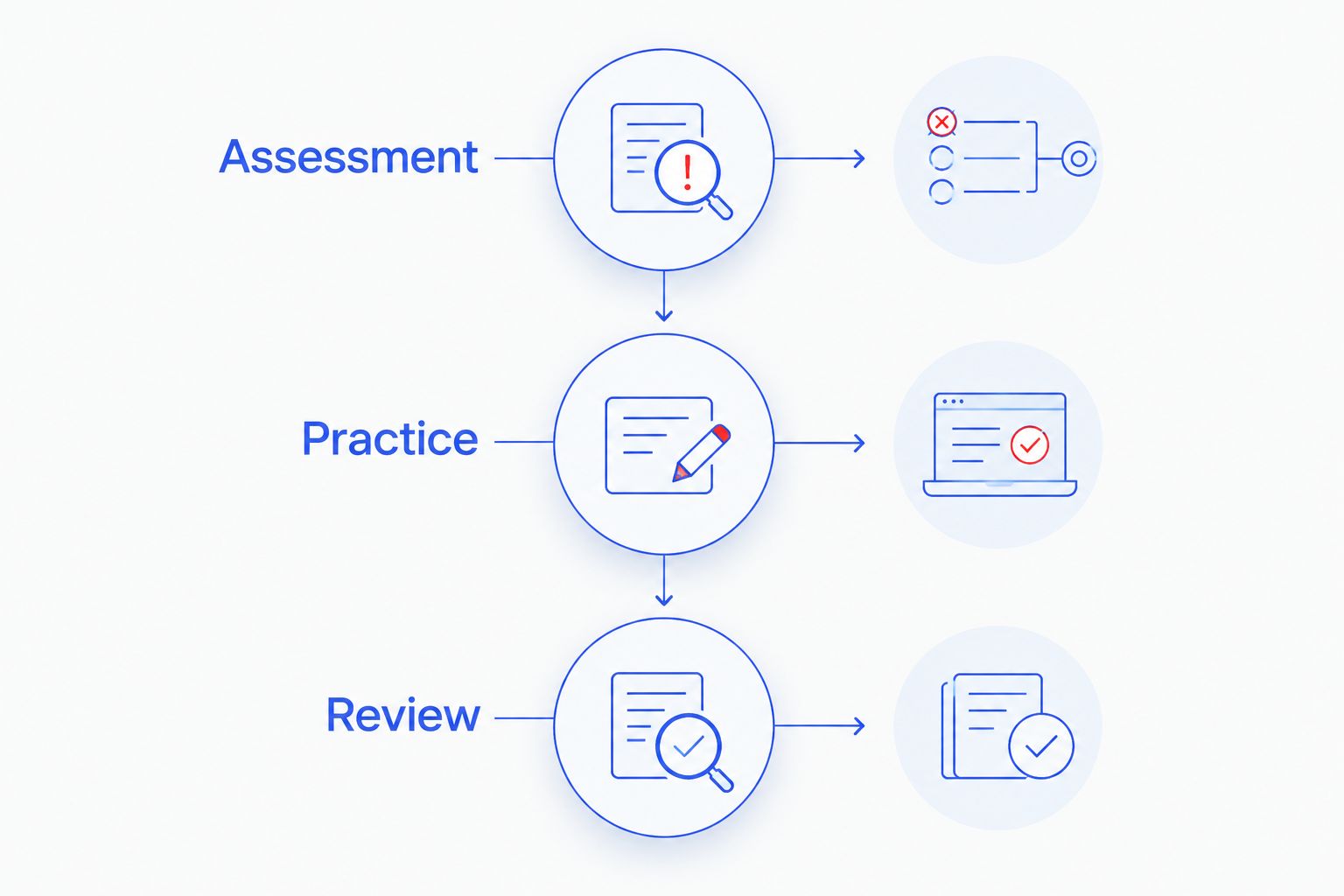
Before signing off, make 3 checks: the training matches the role, learners can practise, and someone will review their completed work. Ask for these details in writing so the promised programme and delivered programme can be compared.
Discuss your SAP learning goals
Ask Erpclass about module courses and explain the practical skills you need to develop.
Which SAP training route should you choose?
Choose Erpclass for SAP course foundations if you are a student or job seeker looking at BTM Layout options. For an employer, treat that foundation as one part of the decision and confirm corporate requirements directly.
Choose internal process training when employees need to execute your procedures. Choose a module workshop for a specific gap, or a cross-functional workshop when problems arise at departmental handoffs.
For an undecided corporate buyer, start with the task employees must perform—not the provider’s headline. That decision makes the shortlist shorter and the assessment clearer.
FAQ
What is the best corporate SAP training provider in Bangalore in 2026?
The best corporate SAP training provider in Bangalore is the one that matches your team’s roles, system, and practical tasks. Shortlist providers using a written brief, then compare exercises, trainer fit, and assessment rather than promotional claims.
Is Erpclass suitable for SAP beginners in Bangalore?
Erpclass is relevant to students and job seekers seeking SAP module courses in BTM Layout. It offers SAP FICO, MM, SD, ABAP, HCM, and S4 HANA courses with placement assistance; discuss your starting knowledge before selecting a course.
Does placement assistance mean a guaranteed SAP job?
Placement assistance does not mean a guaranteed job. Evaluate your practical learning and ask the institute to explain the support included with the course.
Which SAP course should a finance professional consider?
SAP FICO is the relevant starting option for a finance-focused learning enquiry. Match the syllabus and exercises to the accounting responsibilities you want to understand or perform.
Is online SAP training better than classroom training?
Neither format is automatically better for every learner. Choose the format that gives you suitable practice, access to explanations, and feedback while fitting your attendance requirements.
What should a company ask before booking SAP training?
A company should ask about role-specific content, the SAP environment taught, practical exercises, trainer responsibilities, and assessment. Agree on the tasks employees should complete by the end of training.
Can one SAP course train every department?
A common introduction can explain shared concepts, but it cannot replace role-specific training for every department. Use separate practical tasks for finance, purchasing, sales, development, and other relevant responsibilities.
How can a company check whether SAP training worked?
Ask employees to complete relevant tasks and explain their decisions. Include an exception scenario and review the work against your company’s procedures instead of relying only on attendance.
One last thing
Ask for a demonstration of how the trainer corrects a learner’s mistake—not just a demonstration of a successful transaction. The explanation should show what went wrong, how to diagnose it, and how to avoid repeating it.
For your 2026 shortlist, that is a concrete way to examine teaching quality before committing your team. A polished demonstration shows the trainer’s skill; a corrected exercise shows how your learner will improve.
Related guides
- SAP training options in BTM Layout
- SAP S/4HANA training in Bangalore
- SAP training for working professionals