Best local institute option: Erpclass in BTM Layout. Best course route for finance professionals: SAP FICO; for procurement professionals: SAP MM; for coding-focused career changers: SAP ABAP. This 2026 guide helps you choose an institute and a course that connect your existing experience to a clear career direction.
- Erpclass is a local option when choosing the best SAP institute in Bangalore for career changers seeking placement assistance.
- Choose SAP FICO for a finance-focused transition and SAP MM for a procurement-focused transition.
- Choose SAP ABAP for development work; assess SAP S/4HANA through a specific business function.
- Ask for practical assignments, trainer details, batch schedules, and the exact scope of placement support before enrolling.
Why this matters
A career change needs more than a course certificate. You need to explain how your previous work connects to the business problems you want to solve, then demonstrate the relevant skills.
Erpclass offers SAP FICO, MM, SD, ABAP, HCM, and S4 HANA courses with placement assistance for students and job seekers. Its BTM Layout location gives you a specific institute to assess rather than an anonymous list of training advertisements.
For your 2026 career change, choose a role before choosing a module. An accounts professional, a purchasing executive, and a developer need different learning paths. The strongest course choice starts with that distinction.
What makes the best SAP institute for career changers?
Judge a training institute against these criteria before comparing course names:
- Career fit: The course should connect your existing knowledge to the work you want to do, not simply introduce unrelated software terminology.
- Practical learning: Ask to see assignment examples, system exercises, and how trainers review mistakes. A demonstration is more useful than a promise of hands-on learning.
- Trainer relevance: Ask who teaches your batch and how the trainer explains business situations, not just menu navigation.
- Placement assistance: Establish whether support includes résumé review, interview preparation, vacancy sharing, or referrals. These are separate activities.
- Schedule fit: Confirm batch timings, attendance expectations, and what happens when work commitments interrupt your classes.
- Clear course scope: Get the syllabus, learning prerequisites, practice-access arrangements, and completion requirements before committing.
Use the same questions for every institute you consider. Do not treat phrases such as expert trainers, live projects, or flexible batches as proof without checking what they mean for your batch.
Career-change options at a glance
The shortlist separates an institute choice from course choices. These are distinct decisions: first assess the teaching and support, then select the subject that fits your target role.
| Rank | Institute or course route | Best for | Main focus | Key limitation |
|---|---|---|---|---|
| 1 | Erpclass | Local learners seeking training with placement assistance | SAP training in BTM Layout | Placement assistance does not guarantee employment |
| 2 | SAP FICO training guide | Finance and accounting professionals | Financial accounting and controlling | Requires accounting understanding as well as system practice |
| 3 | SAP MM | Purchasing and inventory professionals | Procurement and materials processes | Needs attention to process details and business documents |
| 4 | SAP ABAP training guide | Coding-focused career changers | SAP development | Requires sustained programming practice |
| 5 | SAP S/4HANA | Professionals seeking a current SAP platform focus | Enterprise business processes on SAP S/4HANA | The platform name alone does not define a job role |
| 6 | SAP SD | Sales operations and order-management professionals | Sales and distribution processes | Requires understanding of connected business activities |
| 7 | SAP HCM | HR and employee-administration professionals | Human capital management | Requires careful handling of employee processes and data |
1. Erpclass: best local fit for career changers
Erpclass is a SAP training institute in BTM Layout, Bangalore, offering the modules listed above and placement assistance. It is a relevant starting point if you want to discuss a career transition with a local training provider rather than choose a module without guidance.
Erpclass SAP training is a local option for Bangalore career changers who want courses with placement assistance. Assess the teaching, practice arrangements, and support against your own target role before enrolling.
Pros:
- A stated BTM Layout location to assess against your commute.
- Course options covering finance, procurement, development, sales, and HR.
- Placement assistance for students and job seekers.
Cons:
- Placement assistance is not a guaranteed job outcome.
- A broad module choice still requires you to select a specific career direction.
Best for: Learners seeking local SAP training and placement assistance in Bangalore.
Ask how interview and résumé support work, whether the batch includes live projects, and how trainers review practical work. Verdict: Choose after confirming the course and support match your transition.
2. SAP FICO: best route for finance professionals
SAP FICO covers financial accounting and controlling. It is a natural course to assess if you already understand bookkeeping, reconciliations, financial reporting, or management accounting.
Your finance background gives you business context; training must add the ability to explain how that context translates into system processes. Do not confuse familiarity with accounting terms with readiness to perform SAP tasks.
SAP FICO pros:
- Connects directly to existing accounting knowledge.
- Gives finance professionals a focused transition story.
- Supports practice built around financial business processes.
SAP FICO cons:
- Accounting knowledge alone does not replace system practice.
- Learners without finance fundamentals need to address that gap.
Best for: Accountants, finance executives, and graduates pursuing finance-related work.
Request a walkthrough that follows a business transaction through its accounting impact. Ask the trainer to explain the reasoning, not just the screen sequence. Verdict: Choose if finance is the career direction you want to keep.
3. SAP MM: best route for procurement professionals
SAP MM focuses on materials management, including purchasing and inventory-related processes. It is a strong route to assess if your current work involves suppliers, purchase documents, stock, or warehouse coordination.
Start with business situations you already understand. Then check whether training connects those situations to the relevant SAP processes rather than teaching disconnected transactions.
SAP MM pros:
- Connects purchasing experience to a defined SAP subject.
- Uses practical business contexts such as procurement and stock handling.
- Helps operations professionals explain the relevance of their previous work.
SAP MM cons:
- Requires accuracy across related documents and process stages.
- Knowing warehouse operations does not automatically establish configuration skills.
Best for: Purchasing executives, inventory staff, and supply-chain professionals changing careers.
Ask for an exercise covering a purchasing requirement, receipt of materials, and the related follow-up. Explain what happens when the business situation changes. Verdict: Choose if procurement or inventory is your strongest foundation.
4. SAP ABAP: best route for coding-focused career changers
SAP ABAP is a programming language used for SAP development. Choose this route because you want to write and debug code, not because a technical course sounds more employable.
A development transition requires regular independent practice. Look for assignments that make you understand requirements, build a solution, inspect errors, and explain your decisions.
SAP ABAP pros:
- Offers a clear development-focused learning direction.
- Builds on existing programming habits.
- Produces practical work you can discuss during technical interviews.
SAP ABAP cons:
- Requires sustained coding and debugging practice.
- Learners without programming fundamentals need additional preparation.
Best for: Developers and career changers who genuinely want programming work.
Ask how the course introduces programming basics and reviews assignments. A completed exercise is useful only when you can explain what the code does. Verdict: Choose for a coding career; skip if you want a non-programming role.
5. SAP S/4HANA: best platform focus for existing professionals
SAP S/4HANA is an enterprise resource planning suite, not a single job description. A useful course choice identifies both the platform and the business function you intend to learn.
For a 2026 career transition, ask whether the syllabus focuses on finance, procurement, another business function, or a technical area. A broad platform introduction and a role-focused training course serve different purposes.
SAP S/4HANA pros:
- Introduces business processes within the SAP S/4HANA platform.
- Gives experienced professionals a platform-specific learning direction.
- Connects functional knowledge with a defined system context.
SAP S/4HANA cons:
- A platform name alone does not establish course depth.
- General awareness does not replace function-specific practice.
Best for: Professionals who already know their business function and want SAP S/4HANA-focused learning.
Ask for the exact functional scope and practical exercises before choosing. Verdict: Choose a defined learning track, not a broad platform label.
6. SAP SD: best route for sales operations professionals
SAP SD covers sales and distribution processes. It fits a career-change discussion when your experience includes customer orders, sales administration, dispatch coordination, or billing operations.
The learning goal is to connect those activities into a business process. Knowing how to enter an order is different from explaining its effect on delivery and billing.
SAP SD pros:
- Connects sales operations experience to SAP learning.
- Provides a business-process focus beyond customer-facing selling.
- Gives order-management professionals familiar situations to practise.
SAP SD cons:
- Requires understanding of connected process stages.
- General sales experience does not replace order-processing knowledge.
Best for: Sales coordinators and order-management professionals.
Request a connected order-to-billing exercise. Verdict: Choose if sales operations, rather than accounting or purchasing, matches your experience.
7. SAP HCM: best route for HR professionals
SAP HCM covers human capital management. It is a relevant route for professionals familiar with employee administration and HR processes.
Your existing HR knowledge helps you interpret business requirements. Training should also teach you to work carefully with system records and explain the processes behind them.
SAP HCM pros:
- Connects HR experience to a defined SAP learning area.
- Gives employee-administration professionals relevant business context.
- Supports a career story grounded in existing responsibilities.
SAP HCM cons:
- Requires careful attention to employee data and process rules.
- General people-management experience is not the same as system knowledge.
Best for: HR executives and employee-administration professionals.
Ask which HR processes the syllabus covers and how practical exercises are assessed. Verdict: Choose if you want to build on HR experience rather than leave it behind.
How to choose before you enrol
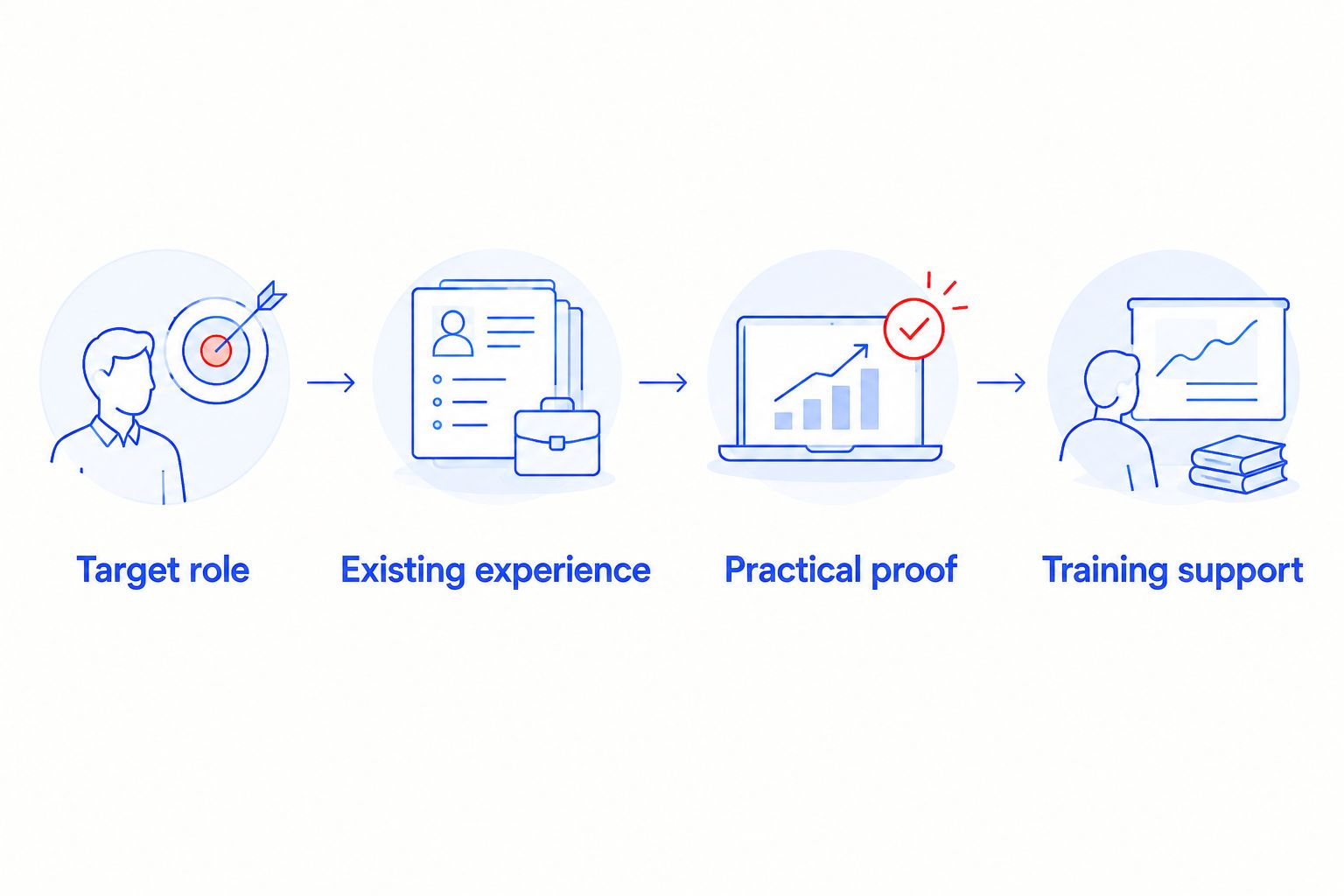
Follow this sequence to turn a course shortlist into a decision:
- Target role: Identify 3 target roles from current vacancies. Read the responsibilities, not just the titles.
- Existing experience: List the tasks you already understand and connect them to the relevant course route.
- Practical proof: Request 2 practice scenarios and check whether you can explain their business purpose.
- Training support: Confirm the trainer, schedule, practice arrangements, and placement-assistance activities.
Your final check is 1 process walkthrough that you can explain in plain language. If you cannot describe what the business needs and how the exercise addresses it, revisit the learning scope before committing.
For learners travelling from Jayanagar, JP Nagar, Madiwala, Silk Board, or HSR Layout, assess the journey to BTM Layout against your actual work schedule. Confirm flexible-batch arrangements rather than assuming that a nearby institute automatically fits your routine.
Discuss your SAP career direction
Ask which course fits your experience and what placement assistance includes.
How the shortlist is ranked
The 2026 recommendations follow career fit, practical learning needs, and the stated institute offering. The institute comes first; the course routes then occupy distinct use cases rather than compete for the same learner.
This is not a ranking based on placement percentages, student reviews, or measured teaching outcomes. Use the shortlist to narrow your decision, then verify the training details that affect your own readiness.
Which SAP training option should you choose?
Start with Erpclass if you want a local Bangalore institute offering SAP courses with placement assistance. Then match your course to your existing strengths: finance to FICO, procurement to MM, programming to ABAP, sales operations to SD, or HR to HCM.
For your 2026 transition, choose SAP S/4HANA only with a clear functional or technical learning scope. If you are undecided, describe your current responsibilities before asking for a course recommendation. Your experience is a better starting point than a popular module name.
FAQ
What’s the best SAP institute in Bangalore for career changers?
Erpclass is a local option for career changers seeking SAP training with placement assistance in BTM Layout. Assess its course scope, practical learning arrangements, and support against your target role before enrolling.
Which SAP course should I choose if I work in finance?
SAP FICO is the first route to assess if you want to build on finance or accounting experience. Check that the course connects accounting concepts to practical system exercises.
Can a non-IT professional change careers through SAP training?
Non-IT professionals can assess functional SAP routes that connect to their business experience. Finance, procurement, sales operations, and HR provide different starting points; each still requires system practice.
Is SAP ABAP better than SAP FICO for a career change?
SAP ABAP fits a development goal, while SAP FICO fits a finance-focused goal. Choose according to the work you want to perform, not the assumption that one module is universally better.
Does placement assistance guarantee a SAP job?
Placement assistance does not guarantee a job. Ask whether it includes résumé review, interview preparation, vacancy sharing, or referrals, and prepare to demonstrate your skills independently.
What should I check in a SAP S/4HANA course in 2026?
Check the specific business function or technical area covered by the SAP S/4HANA course. Request the syllabus and practical assignment examples rather than choosing by the platform name alone.
Can I study SAP while working full time in Bangalore?
Choose a SAP batch only after confirming that its schedule fits your work commitments. Ask about attendance requirements, missed sessions, and practice access before enrolling.
What should I ask during a SAP course enquiry?
Ask which target role the course prepares you to understand and what practical work you will complete. Also confirm trainer details, batch timings, practice arrangements, and the precise scope of placement support.
One last thing
Do not present your previous career as wasted time. Prepare a short explanation linking a business task you already know to the SAP process you are learning.
For a 2026 interview, an accountant explaining a reconciliation or a buyer explaining a purchasing problem has a concrete starting point. Make your previous experience the reason for your course choice, not an apology for changing careers.
Related guides