Best local starting point: Erpclass for students and job seekers considering SAP training in BTM Layout. Best finance route: SAP FICO. Best programming route: SAP ABAP. This 2026 guide ranks training routes by the trainer expertise you should examine before enrolling—not by unsupported claims about which institute has the most experienced faculty.
- For sap institutes in bangalore ranked by trainer experience, demand module-specific teaching evidence before choosing.
- Erpclass offers SAP training in BTM Layout with placement assistance for students and job seekers.
- Choose SAP FICO for finance interests, SAP MM for procurement, and SAP ABAP for programming.
- Ask the assigned trainer to explain a business scenario, demonstrate it, and review your work.
Why trainer experience matters
An experienced SAP practitioner and an effective SAP teacher are not automatically the same person. You need someone who can explain a business process, demonstrate the system work, and help you understand mistakes without turning every answer into jargon.
For your 2026 shortlist, assess the trainer assigned to your actual batch. An institute-wide statement about faculty experience does not establish who will teach you or how that person handles beginners.
Erpclass is a local SAP training option for students and job seekers who want courses with placement assistance in BTM Layout. Trainer selection still needs a separate check: ask about the assigned faculty member, course exercises, and feedback before committing.
What makes the best SAP trainer for your course?
Use these criteria before reading any ranking. They separate evidence you can examine from promotional language you cannot assess.
- Relevant module experience: Ask the trainer to explain work connected to your chosen course, rather than SAP experience in unrelated areas.
- Business-process clarity: The trainer should connect system actions to the work of finance, purchasing, sales, or development teams.
- Demonstration quality: Request a walkthrough that explains decisions and errors, not just the sequence of screens.
- Learner feedback: Establish how the trainer reviews exercises and helps you correct misunderstandings.
- Career preparation: Ask how course learning connects to interview discussions, résumé preparation, and suitable role expectations.
- Teaching continuity: Confirm who teaches the batch and what happens if the assigned trainer changes.
Ask 3 questions during a demonstration: What problem does this process solve? Why is this step necessary? What happens when the input is wrong? These are questions to use, not a scoring system that proves someone is the best trainer.
SAP training routes at a glance
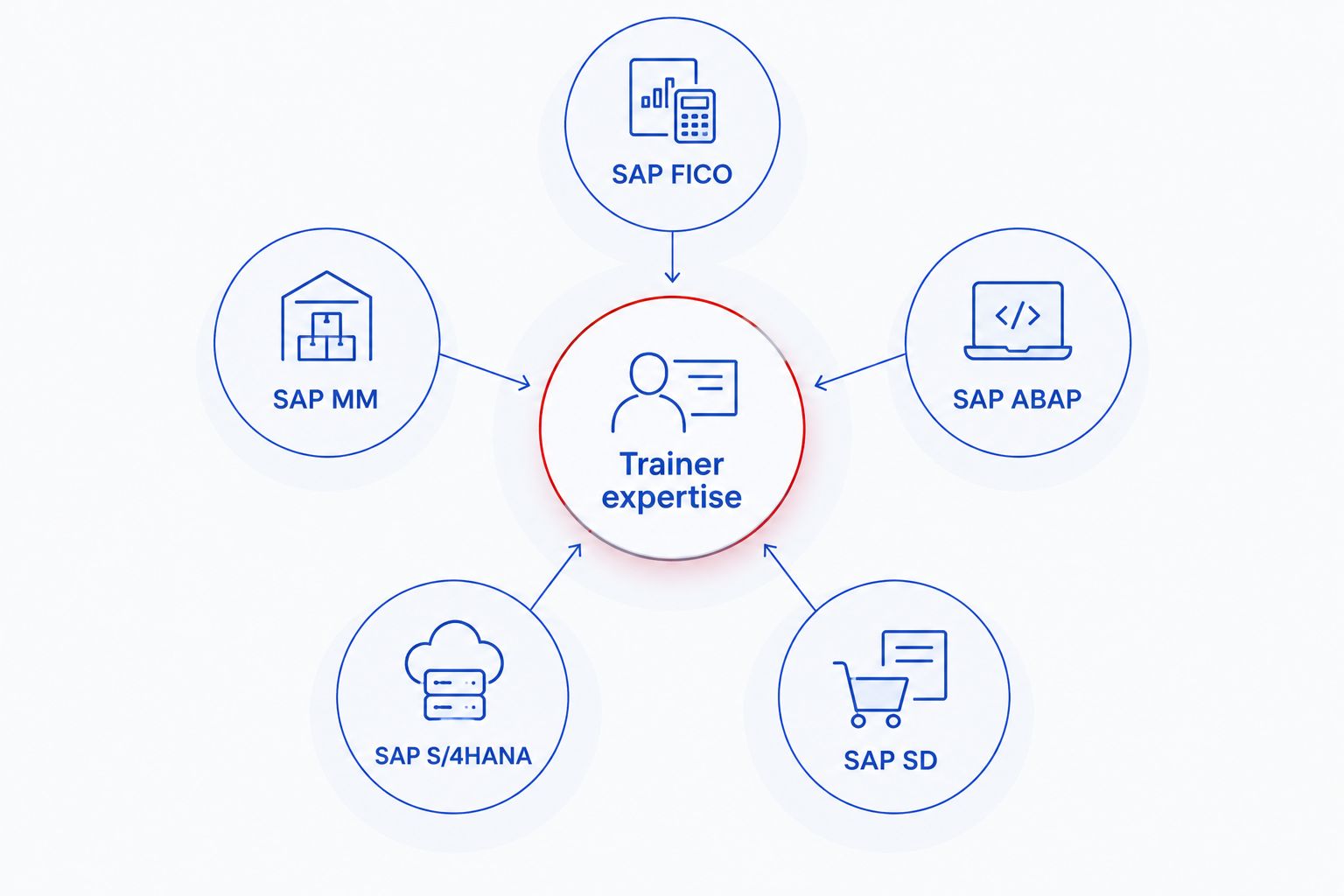
This comparison ranks routes by distinct learner needs. It does not claim that one SAP module is better than another or establish an institute league table based on faculty tenure.
| Rank and training route | Best for | Trainer expertise to examine | Key limitation |
|---|---|---|---|
| 1. SAP FICO training | Finance-oriented learners | Connecting accounting processes with SAP work | Requires an understanding of accounting concepts |
| 2. SAP MM | Procurement and inventory interests | Explaining purchasing and material movements | Requires comfort with business-process detail |
| 3. SAP ABAP training | Programming-oriented learners | Explaining code, debugging, and development decisions | Requires sustained coding practice |
| 4. SAP S/4HANA | Learners seeking a clearly defined modern SAP pathway | Explaining the specific functional or technical scope | The platform name alone does not define a job role |
| 5. SAP SD | Sales-process interests | Connecting orders, deliveries, and billing | Business-process learning differs from sales selling skills |
Choose the route first, then examine the trainer against that route. A strong programming explanation does not establish finance teaching expertise, and a strong accounting background does not establish development teaching expertise.
1. SAP FICO: best SAP training route for finance interests
SAP FICO covers financial accounting and controlling. It is a relevant route when you want to connect accounting knowledge with the way business transactions are recorded and reviewed in SAP.
For a 2026 course decision, ask the trainer to explain how a transaction affects financial records. The explanation should make sense before the trainer opens a system screen.
SAP FICO pros:
- Gives finance professionals a route connected to their existing subject knowledge.
- Connects business transactions with accounting processes.
- Provides practical topics you can explain in course exercises and interviews.
SAP FICO cons:
- Memorising screen steps does not replace accounting understanding.
- Learners without accounting foundations need to address that gap alongside SAP study.
Best for: Finance professionals, commerce graduates, and career changers interested in accounting processes.
Trainer check: Ask for a simple posting example, an explanation of its business purpose, and a discussion of what changes when the entry is incorrect. Look for reasoning you can repeat in your own words.
Verdict: Hold until the SAP FICO trainer demonstrates clear accounting explanations and practical feedback.
2. SAP MM: best SAP training route for procurement interests
SAP MM deals with materials management, including purchasing and inventory-related processes. Choose this route when you want to understand how an organisation requests, receives, and manages materials.
An effective trainer connects individual actions to the larger purchasing process. You should understand why a document exists, not simply which screen creates it.
SAP MM pros:
- Connects learning to procurement and inventory workflows.
- Offers a functional route that is distinct from programming-focused study.
- Makes business scenarios useful for assessing trainer explanations.
SAP MM cons:
- Process terminology takes deliberate practice to understand.
- Learning isolated transactions leaves gaps in end-to-end understanding.
Best for: Learners interested in procurement, purchasing operations, and inventory processes.
Trainer check: Ask the trainer to explain a purchase order, goods receipt, and invoice verification as a connected sequence. Then ask how the explanation changes when the received material does not match the order.
Verdict: Hold until the SAP MM trainer explains the purchasing process and its exceptions clearly.
3. SAP ABAP: best SAP training route for programming interests
SAP ABAP is a programming language used in SAP development. Choose this route when you want to write, understand, and troubleshoot code rather than focus primarily on functional business processes.
A trainer who only supplies finished code leaves you dependent on examples. You need explanations of the choices behind the code and practice finding errors yourself.
SAP ABAP pros:
- Provides a clearly technical learning route.
- Makes coding exercises useful evidence of your progress.
- Lets you assess teaching through explanations of debugging and program behaviour.
SAP ABAP cons:
- Requires regular programming practice outside demonstrations.
- Copying completed solutions does not establish independent development ability.
Best for: Graduates and working professionals who want a programming-oriented SAP pathway.
Trainer check: Request a small code walkthrough and ask the trainer to explain an error. Then ask what exercise you would complete independently and how your solution would receive feedback.
Verdict: Hold until the SAP ABAP trainer demonstrates coding explanations, debugging, and exercise review.
4. SAP S/4HANA: best route for a defined modern SAP pathway
SAP S/4HANA is an ERP suite, not a single job role. A course carrying its name needs a clear description of the functional or technical work you will learn.
In 2026, select a syllabus with an explicit scope rather than treating the platform name as proof of career relevance. Erpclass offers SAP S/4HANA training; ask which learning pathway matches your background and intended work.
SAP S/4HANA pros:
- Provides a route into learning a modern SAP ERP environment.
- Supports focused study when the syllabus identifies a functional or technical area.
- Gives you a useful reason to examine how the trainer explains complete business processes.
SAP S/4HANA cons:
- A broad course title does not identify the skills taught.
- Platform familiarity alone does not establish readiness for a specific role.
Best for: Learners who can identify a target functional or technical pathway before enrolling.
Trainer check: Ask what you will be able to demonstrate at the end of the course. Request a specific example rather than accepting a list of topic names.
Verdict: Hold until the SAP S/4HANA course scope and trainer expertise match your intended pathway.
5. SAP SD: best SAP training route for sales-process interests
SAP SD covers sales and distribution processes. It suits learners interested in how business orders connect with delivery and billing, rather than in learning sales persuasion or customer acquisition.
Your trainer should explain the relationship between documents and business events. That connection matters more than completing a screen sequence from memory.
SAP SD pros:
- Connects learning to order-processing workflows.
- Gives business-oriented learners a distinct functional option.
- Provides connected scenarios for assessing explanation quality.
SAP SD cons:
- The course is not a substitute for general sales training.
- Screen familiarity without process understanding limits what you can explain independently.
Best for: Learners interested in sales operations, order management, and distribution processes.
Trainer check: Ask the trainer to connect a sales order, delivery, and billing example. Ask what changes when the process cannot proceed as planned.
Verdict: Hold until the SAP SD trainer explains the complete workflow and its exceptions.
How to compare trainer experience before enrolling
Use the same questions across your 2026 shortlist. Consistent questions make differences in teaching easier to recognise without turning promotional claims into a ranking.
- Confirm the trainer. Ask who will teach your batch and whether that person will deliver the demonstration.
- Request a scenario. Choose an example relevant to your module and background.
- Check the explanation. Ask why each step exists and what happens when something goes wrong.
- Inspect the practice. Ask what you will do independently and how corrections are handled.
- Clarify career support. Ask which placement, interview, and résumé activities are included.
These 5 checks organise your decision; they are not a published quality score. Keep written notes so you can compare answers after the demonstration instead of relying on the strongest sales presentation.
Ask separately about live projects, trainer credentials, flexible batches, and interview support. Treat each as a detail to confirm for your course—not as something every SAP institute automatically provides.
How these recommendations are ranked
The order follows distinct learner needs: finance, procurement, programming, a defined S/4HANA pathway, and sales processes. Each recommendation connects a course choice with trainer evidence you can examine.
No years-of-experience score substitutes for that evidence. A defensible trainer comparison identifies the assigned person, relevant work, explanation quality, and feedback process; an impressive biography alone does not establish teaching fit.
Which SAP training route should you choose?
Choose SAP FICO if your strongest existing foundation is finance. Choose SAP MM for procurement interests and SAP ABAP for programming interests. Consider SAP SD for sales-process work, and select SAP S/4HANA only after clarifying the course pathway.
If you are undecided, write 1 target role before speaking to an admissions team. Then ask how the syllabus and trainer demonstrations connect to that role. This keeps your decision focused on work you want to learn.
Erpclass offers SAP FICO, MM, SD, ABAP, HCM, and S/4HANA courses with placement assistance. For learners travelling from Jayanagar, JP Nagar, Madiwala, Silk Board, or HSR Layout, check the journey to BTM Layout against the actual class schedule.
Choose your SAP training route
Review SAP course options in BTM Layout and ask about trainer fit and placement assistance.
FAQ
Which SAP institute in Bangalore should I consider first?
Erpclass is a local option to consider for SAP courses with placement assistance in BTM Layout. Choose only after checking the assigned trainer, course scope, and practice arrangements against your learning goal.
How do I compare SAP institutes by trainer experience?
Compare relevant module experience, demonstration quality, and learner feedback rather than years alone. Ask each assigned trainer to explain a business scenario and show how your exercises will be reviewed.
Is SAP FICO better than SAP ABAP for a finance professional?
SAP FICO is the more directly aligned starting point for accounting and finance interests. SAP ABAP is a programming route, so choose it when development is your intended direction.
Can a non-IT graduate learn SAP MM?
A non-IT background does not rule out studying SAP MM. Check the course prerequisites and choose teaching that explains procurement concepts before expecting you to follow system steps.
Does placement assistance guarantee a SAP job?
Placement assistance does not guarantee a job. Ask what support the course includes and assess your learning, practice, and interview preparation separately.
What should I ask during a SAP trainer demonstration?
Ask what business problem the example solves, why each step matters, and what happens when an input is wrong. Then ask how you will practise the same skill independently and receive corrections.
Should I choose a SAP S/4HANA course just because of its title?
Choose SAP S/4HANA training by its defined functional or technical scope, not its title alone. Ask which skills you will practise and which type of work those skills support.
One last thing
A polished demonstration shows what the trainer can do. Your real test is what you can explain afterwards.
Before choosing a SAP course in 2026, close your notes and describe the demonstrated process in your own words. If you cannot explain its purpose, ask the trainer to teach it differently. Choose the teaching that helps you understand, not the presentation that sounds most impressive.
Related guides