For learners searching for nextgen sap academy alternatives in 2026, Erpclass is a strong fit for SAP training in BTM Layout with placement assistance. Choose a local institute when you want guided learning and career support; choose independent study when you want to control your learning schedule.
- Erpclass suits learners seeking SAP training in BTM Layout with placement assistance.
- Compare nextgen sap academy alternatives by module fit, practice opportunities, trainer access, and career support.
- Finance learners should assess SAP FICO; procurement learners should assess SAP MM.
- Independent study gives schedule control but requires you to organise practice and job preparation yourself.
Why this matters
Changing your training provider will not fix a course that targets the wrong career path. First decide whether you want to work with finance processes, purchasing, programming, or a broader business-system environment.
For your 2026 shortlist, separate the course from the career support around it. A syllabus tells you what you will study. Placement assistance tells you that support exists, but you still need to understand its scope before enrolling.
Start with Erpclass if you want a Bangalore-based SAP training institute. It offers SAP FICO, MM, SD, ABAP, HCM, and S4 HANA courses, with placement assistance for students and job seekers.
Choose the training route that addresses your actual gap: knowledge, practical application, or preparation for interviews. A different institute name is not a substitute for a better learning plan.
SAP training alternatives at a glance
Use this table to compare learning routes rather than relying on institute rankings. Each route solves a different problem, and each comes with a responsibility you must accept.
| Training route | Best for | Main advantage | Main limitation | What to check before choosing |
|---|---|---|---|---|
| Local institute training | Learners wanting guided study and career support | A structured training relationship | Course attendance must fit your routine | Module, teaching format, practice access, placement-assistance scope |
| Independent study | Learners comfortable planning their own work | Control over study order and schedule | You organise feedback and job preparation yourself | Learning materials, practice arrangements, progress checks |
| Instructor-led online training | Learners prioritising remote attendance | No journey to a classroom for online sessions | Remote attendance does not establish teaching quality | Live interaction, doubt support, practice arrangements |
| Employer-supported training | Working professionals learning for a defined workplace need | A clear connection to your current responsibilities | The training objective can remain specific to your employer | Approval, syllabus, work relevance, assessment |
Keep your current course on the shortlist until another route meets your requirements more clearly. If your present training already provides the right module, useful feedback, and a workable routine, switching creates extra decisions without necessarily solving a problem.
1. Erpclass: best for local SAP training with placement assistance
Erpclass is a SAP training institute in BTM Layout, Bangalore, serving students and job seekers. Its course range includes SAP FICO, SAP MM, SAP ABAP, and S4 HANA, alongside SAP SD and SAP HCM.
Best for: Fresh graduates, career changers, and finance professionals seeking local SAP training with placement assistance.
Where this option shines
- You can start with a module linked to your intended work rather than choosing a general course without a role in mind.
- The BTM Layout location gives you a specific place to assess when planning attendance.
- Placement assistance is part of the stated offer for students and job seekers.
- The course range covers finance, purchasing, programming, sales, and human-resources learning paths.
Where this option falls short
- Placement assistance is not a guaranteed job; you remain responsible for applications and interview performance.
- A BTM Layout location is useful only if the attendance arrangements fit your routine.
- A broad course range does not establish which module suits your background. You must make that decision before enrolling.
Ask about the trainer, practical assignments, batch schedule, and support for interviews and résumés. Request a clear explanation of what the placement assistance includes rather than treating the phrase as a complete service description.
For learners travelling from Jayanagar, JP Nagar, Madiwala, Silk Board, or HSR Layout, check the actual journey against the proposed class schedule. Verdict: Buy into the local training route when the module and attendance plan fit; hold until those details are clear.
2. Independent study: best for learners who can direct their own progress
Independent study puts you in charge of what you learn and when you study. It is a learning route, not a replacement for every service an institute provides.
Best for: Learners who already know their target module and can maintain a study routine without regular prompting.
Where independent study shines
- You can revisit a difficult topic before moving on.
- You choose the order of your study activities.
- You can focus revision on the processes most relevant to your intended role.
Where independent study falls short
- You must arrange practical work and useful feedback yourself.
- Completing learning materials does not establish interview readiness.
- Without a clear plan, you can keep collecting resources instead of demonstrating understanding.
Set a specific outcome for each topic: explain the process, practise the task where access permits, and describe what you learned. Do not treat watching a lesson as proof that you can apply it.
Verdict: Buy into independent study if you can organise practice and feedback; skip it as your only route if you need close guidance.
3. Instructor-led online training: best for avoiding a classroom commute
Instructor-led online training lets you attend teaching sessions remotely. Assess the teaching and support arrangements separately from the convenience of the format.
Best for: Learners whose work, travel, or home commitments make regular classroom attendance difficult.
Where online training shines
- You remove the classroom journey from your attendance plan.
- You can choose remote instruction as a format without changing your target module.
- Live sessions provide a setting in which to ask questions, provided interaction is part of the course.
Where online training falls short
- You need a suitable device, connection, and place to study.
- A remote format does not confirm access to practical exercises or individual feedback.
- Scheduled online classes still require you to protect study time.
Before selecting an online course in 2026, ask how questions are handled and how practical work is reviewed. Clarify what happens when you miss a session rather than assuming recordings or replacement classes are included.
Verdict: Buy into online training when remote attendance solves a real scheduling problem; hold until interaction and practice arrangements are clear.
4. Employer-supported training: best for a defined workplace need
Employer-supported training is worth pursuing when your organisation has a specific SAP learning requirement. Start with the work you need to perform, then discuss the training that addresses it.
Best for: Working professionals whose current responsibilities connect directly to an approved learning objective.
Where employer-supported training shines
- The learning objective can connect to work you already understand.
- You can discuss the syllabus against a defined business process.
- Your manager can help clarify which capabilities matter in your current role.
Where employer-supported training falls short
- Participation depends on your employer's approval and arrangements.
- A workplace-focused syllabus can be narrower than your career-change goals.
- Training for your current responsibilities does not automatically prepare you for a different role.
Ask your manager to define the expected outcome before you select a course. Keep your longer-term career objective separate from the immediate workplace requirement.
Verdict: Buy into employer-supported training when it matches an approved work need; skip waiting for it if no training arrangement exists.
Choose the SAP module before choosing the institute
For your 2026 decision, the module should follow the kind of work you want to understand. A familiar course name is not enough. You should be able to explain why its subject matter matches your background or intended role.
| Learning path | What it focuses on | Best for assessing | Main caution |
|---|---|---|---|
| SAP FICO | Financial accounting and controlling | Finance and accounting interests | Software learning does not replace understanding financial processes |
| SAP MM | Materials management and purchasing processes | Procurement and inventory interests | Learn the business process, not just the screen sequence |
| SAP ABAP | Programming within the SAP environment | Coding and technical-development interests | Programming requires practice, not only lesson attendance |
| SAP S/4HANA | SAP's enterprise business-system environment | Learners assessing a specific functional or technical path | Confirm the course scope; the system name alone is too broad |
If you are a finance professional, start by assessing SAP FICO. If purchasing and inventory interest you, assess SAP MM. If you want to write and understand code, assess SAP ABAP.
For S/4HANA, ask which processes and skills the course actually covers. Choose a syllabus you can explain in terms of work, not a title that sounds current.
These are starting points for a discussion, not automatic career assignments. Your education, existing work experience, and preferred tasks should shape the final choice.
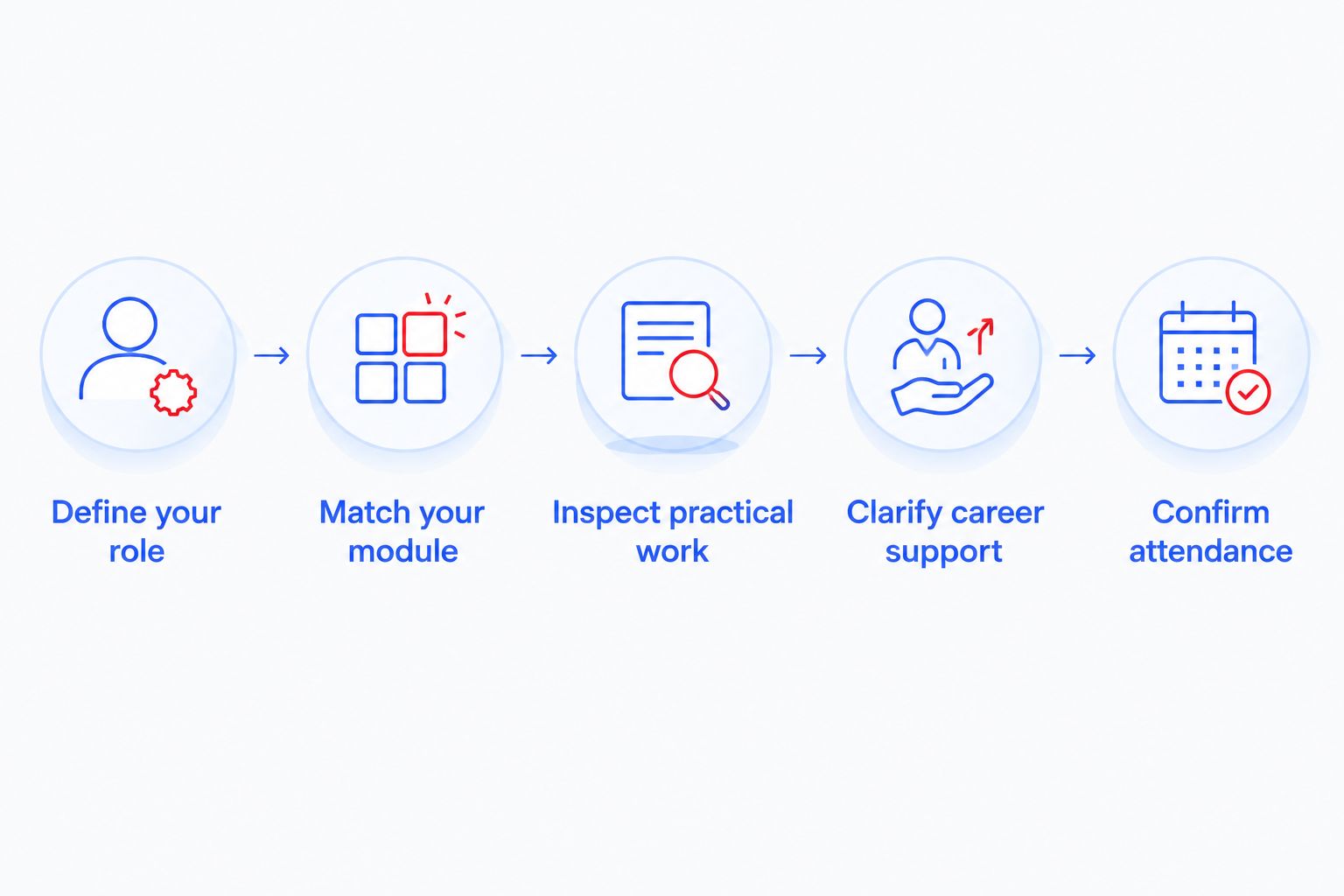
A practical shortlist process for 2026
Use this sequence before committing to any training route. It keeps the decision focused on learning outcomes instead of promotional wording.
Define your role
Write down the work you want to understand or perform. Finance processes, purchasing processes, and programming require different learning plans. Avoid beginning with a promise of employment and working backwards to a module.
Match your module
Request the syllabus and connect its topics to your intended work. Ask which prior knowledge helps and which foundations the course covers. A course is easier to assess when its purpose is clear.
Inspect practical work
Ask what you will do during training, how you will receive feedback, and what access is required. If live projects are discussed, ask the trainer to explain the actual tasks. Do not substitute a promotional label for an assignment description.
Clarify career support
Ask whether the support includes interview preparation, résumé review, job-opening information, or another defined activity. Distinguish placement assistance from a job guarantee. Keep the answer specific enough that you know what to expect.
Confirm attendance
Check the schedule against work, family commitments, and travel. Ask about flexible batches or weekend arrangements if you need them; confirm the current options directly rather than assuming they are available.
A workable routine matters. The strongest syllabus will not help you if you repeatedly miss the teaching and practice sessions needed to follow it.
Use the same questions for every route on your shortlist. Comparable answers make the decision clearer than a collection of unrelated claims.
Discuss your SAP training goals
Explore SAP courses in BTM Layout and ask about placement assistance.
When switching training providers makes sense
Switch when you have identified a specific mismatch and the replacement addresses it. The reason should be concrete enough to explain in a sentence.
- Module mismatch: Your course does not match the work you want to pursue.
- Attendance mismatch: The teaching schedule conflicts with commitments you cannot change.
- Practice mismatch: Your learning needs require practical work or feedback beyond your current arrangements.
- Support mismatch: You need a clearly defined form of career support that your present route does not provide.
These are decision criteria, not claims about any particular academy. Before changing providers, ask your current trainer whether the issue can be resolved within your existing course.
Stay with your current provider if the module fits, the teaching works for you, and the support meets your needs. Switching is useful when it solves a problem, not simply because another course appears in a search result.
FAQ
What’s the best NextGen SAP Academy alternative for local training?
Erpclass is a strong fit for learners seeking SAP training in BTM Layout with placement assistance. Confirm the module, attendance arrangements, practical work, and support scope before enrolling.
Which SAP course should a finance professional assess first?
SAP FICO is the first learning path to assess for finance and accounting interests. Check that the syllabus connects system tasks to financial processes rather than teaching only screen navigation.
Is SAP MM or SAP ABAP better for a career change?
SAP MM fits purchasing and materials-management interests, while SAP ABAP fits programming interests. Choose according to the work you want to do, not a general claim that one module is better.
Does placement assistance mean a guaranteed SAP job?
No, placement assistance is not a guaranteed job. Ask what support is included and keep responsibility for your applications, preparation, and interview performance.
Is online SAP training better than classroom training?
Online training is a better attendance format when avoiding a classroom commute is your priority. Teaching quality, practical work, and feedback must still be assessed separately.
What should I ask before joining SAP training in 2026?
Ask about the syllabus, trainer, practical assignments, batch schedule, and placement-assistance scope. Request specific explanations of live projects, interview preparation, and résumé support if these are offered.
Should I switch if my current SAP course is working well?
No, keep your current course when its module, teaching, and support meet your needs. Change providers only when you can identify a specific problem that the new route addresses.
One last thing
Before enrolling, ask yourself: can you explain the business problem your chosen module helps you understand? If your answer is only the course name, return to the syllabus.
For a 2026 career move, a clear learning objective is more useful than collecting course titles. Choose the module, confirm the practice plan, and understand the support before making the commitment.
Related guides
- SAP training institutes in BTM Layout, Bangalore
- SAP institutes in Bangalore for career changers
- SAP FICO training institutes in Bangalore
- Online SAP training for Bangalore learners