
SAP Completes Dremio Acquisition in Latest AI Data Push – The ERP giant is on a buying spree as it races to build the infrastructure enterprises need to run agentic AI at scale.
Table of Contents
SAP has officially closed its purchase of data lakehouse company Dremio, marking one of the most important enterprise AI infrastructure moves of 2026. Here’s the full breakdown — what changed, why it matters, and what IT leaders should do next.
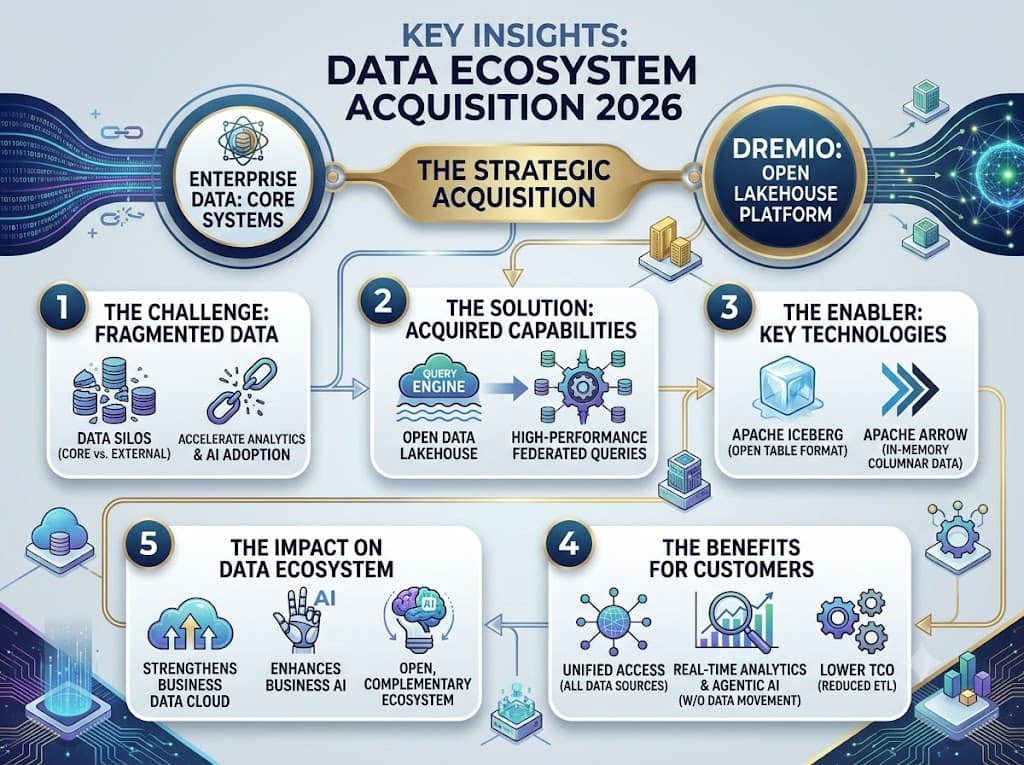
What Just Happened: SAP–Dremio Deal Closes
SAP has officially completed its acquisition of Dremio, an open, high-performance data lakehouse platform, the company confirmed from its headquarters in Walldorf, Germany, and Austin, Texas. The closing marks the finish line of a deal that SAP first announced in early May 2026, and it gives SAP direct ownership of a technology that lets enterprises query and analyze data wherever it lives, without copying it into a separate system first.
SAP frames the move around one core goal: helping customers combine SAP data with non-SAP data to power real-time analytics and agentic AI workloads, without the cost and delay of moving or converting that data first. In plain terms, SAP wants to remove the plumbing problem that slows down almost every serious enterprise AI project.
Key takeaway: SAP didn’t just buy a data tool. It bought the connective tissue that lets AI agents see and act on data across an entire enterprise landscape — SAP systems and everything else — without expensive data migration projects.
Deal Timeline at a Glance
This acquisition didn’t happen in isolation. It’s the latest step in a deliberate, multi-month buildout of SAP’s AI data foundation. The table below lays out how the pieces connect.
| Date | Milestone | Significance |
|---|---|---|
| March 2026 | SAP announces intent to acquire Reltio | Adds master data management to unify customer and product records |
| May 4, 2026 | SAP announces Dremio and Prior Labs acquisitions | Targets the data layer (Dremio) and tabular AI models (Prior Labs) |
| May 2026 | SAP Sapphire 2026 keynote | SAP outlines its Business AI Platform and agentic AI governance plans |
| Q3 2026 (planned) | Expected close of Dremio deal, pending regulatory approval | Original closing target set at announcement |
| July 6, 2026 | SAP completes the Dremio acquisition | Deal closes ahead of the original Q3 target |
What Is Dremio, and Why Did SAP Want It?
Dremio built its reputation on one idea: enterprises shouldn’t have to move data into a data warehouse before they can analyze it. Its lakehouse architecture lets teams run fast, SQL-based queries directly against data sitting in cloud storage, cutting out the time-consuming and expensive extract-transform-load (ETL) cycles that traditional data warehouses require.
For SAP, this capability solves a very specific and very common enterprise headache. Most large organizations run SAP for finance, supply chain, and operations, while also running dozens of other systems — Salesforce, Workday, custom data lakes, third-party analytics tools, and more. Getting AI agents to reason across all of that data usually means expensive integration projects that can take months.
Dremio changes that equation. It plugs into SAP Business Data Cloud and SAP HANA Cloud, letting customers blend SAP and non-SAP data on the fly, run AI workloads against it, and skip the heavy data-movement tax that normally comes with enterprise analytics.
What Dremio brings to SAP’s stack
- Zero-copy data access: Query data in place rather than duplicating it across systems.
- Open lakehouse architecture: Works with open table formats rather than locking customers into a single proprietary format.
- Real-time analytics: Supports live queries for AI agents that need current, not stale, business data.
- Cost efficiency: Reduces the storage and compute overhead that comes from copying data multiple times across systems.
The Bigger Picture: SAP’s Enterprise AI Data Buildout
Dremio is one piece of a much larger puzzle. On the very same day SAP announced the Dremio deal, it also revealed a second acquisition: Prior Labs, a company that builds tabular foundation models (TFMs) — AI models purpose-built for structured business data rather than the free text that large language models excel at.
SAP committed roughly $1.17 billion over four years to help scale Prior Labs, which will continue operating as an independent entity. The logic here is straightforward: general-purpose LLMs are excellent at language, but they often struggle with structured tabular data like payment histories, supplier risk scores, or churn indicators. Tabular foundation models fill that gap, giving SAP a second, complementary AI engine built specifically for the kind of data that lives inside ERP systems.
| Acquisition | Category | What It Solves |
|---|---|---|
| Reltio | Master data management | Creates one trusted, unified view of customer and product data |
| Dremio | Data lakehouse platform | Connects SAP and non-SAP data without costly data movement |
| Prior Labs | Tabular foundation models | Delivers AI models tuned for structured business data |
Together, these three moves point toward one destination: turning SAP Business Data Cloud, launched in 2025, into a full enterprise data platform capable of supporting agentic AI at scale — not just chatbots that answer questions, but autonomous agents that can take action inside core business processes.
Why This Deal Matters for CIOs and Data Leaders
SAP’s own leadership has been candid about the real bottleneck holding back enterprise AI. It isn’t model quality. According to SAP CTO Philipp Herzig, the more common failure point is data readiness — AI agents can only perform as well as the data they can access, and in most enterprises, that data sits scattered across disconnected systems, formats, and access rules.
“Enterprise AI doesn’t stall because the models aren’t good enough — it stalls because the data isn’t ready.”
That statement captures the thinking behind this entire acquisition run. SAP CEO Christian Klein has echoed a similar point, noting that AI agents often lack a deep enough understanding of business context and processes to deliver consistently accurate outcomes — a gap that becomes especially risky once agents start operating inside mission-critical workflows rather than sitting on the sidelines as advisory tools.
For CIOs, this reframes the AI conversation. The question isn’t just “which AI model should we use?” It’s “is our data infrastructure even capable of feeding an AI agent the right information at the right time?” SAP is betting that most enterprises will answer “no” — and that it can sell them the fix.
The $108 Billion Data Problem Behind the Deal
SAP isn’t inventing this problem out of thin air. Independent research backs up the scale of the issue. According to an analysis from Hitachi Vantara, poor data infrastructure contributes to an estimated $108 billion in wasted AI spending every year across enterprises — money spent on AI initiatives that stall or underdeliver because the underlying data isn’t ready to support them.
At the same time, AI budgets keep climbing. IT leaders expect AI spending to increase by as much as 76% over the next two years, even as they acknowledge that data quality and accessibility remain major obstacles. That combination — rising investment paired with a persistent readiness gap — is exactly the opening SAP is trying to fill with Dremio, Reltio, and Prior Labs.
Enterprise AI Spending Outlook vs. the Data Readiness Gap%$108BWasted AI Spend(annual, data issues)+76%Expected AI SpendGrowth (2 yrs)3Major Data/AI Deals(Reltio, Dremio, Prior Labs)
Sources: Hitachi Vantara data complexity analysis; SAP corporate announcements, May–July 2026. Figures illustrate the scale mismatch between AI investment growth and data readiness — the exact gap SAP’s acquisitions target.
How SAP Now Stacks Up Against Snowflake and Databricks
The data lakehouse space has largely been defined by Snowflake and Databricks over the past several years, with SAP historically playing more of a partner role than a direct competitor — SAP and Snowflake announced a partnership to unite their cloud products in late 2025. Owning Dremio changes SAP’s position from partner to platform owner.
| Capability | SAP (post-Dremio) | Snowflake | Databricks |
|---|---|---|---|
| Native ERP data access | Deep, first-party | Via partnership/connectors | Via partnership/connectors |
| Open lakehouse architecture | Yes (via Dremio) | Partial | Yes |
| Tabular foundation models | Yes (via Prior Labs) | Limited | Limited |
| Master data management | Yes (via Reltio) | No native offering | No native offering |
| Agentic AI governance layer | In development (per Sapphire 2026) | Emerging | Emerging |
This shift matters because it lets SAP pitch itself as a single vendor that can own the entire chain — from raw data, to unified master records, to AI-ready models, to the agents that act on all of it — rather than asking customers to stitch together best-of-breed tools from multiple vendors.
Real-World Signal: Amer Sports and the Data Modernization Push
This isn’t a theoretical problem SAP invented to sell software. Amer Sports, which began its RISE with SAP transformation journey last year, has already pointed to data modernization as a critical part of its broader digital transformation — specifically to support more advanced forecasting and inventory management across its global operations.
That example illustrates exactly the kind of use case SAP is targeting with Dremio: a large, multi-brand enterprise that needs to combine data from many sources to make faster, more accurate operational decisions, without months of custom integration work standing in the way.
What’s Next for SAP Business Data Cloud
SAP has signaled that this is just the beginning of a larger platform shift. At SAP Sapphire 2026, CEO Christian Klein previewed fundamental changes to SAP’s portfolio, including how the company plans to govern the agentic AI layer for customers and infuse deeper domain knowledge into SAP’s AI agents.
Expect SAP to continue folding Dremio’s lakehouse capabilities, Reltio’s master data tools, and Prior Labs’ tabular models directly into SAP Business Data Cloud over the coming quarters, positioning it as the default data foundation for any enterprise running SAP alongside other systems.
What to watch for next
- Deeper native integration between Dremio and SAP HANA Cloud
- New agentic AI governance and compliance tooling announced at Sapphire 2026
- Progress on the pending Reltio acquisition, expected to close later in 2026
- Early customer case studies showing measurable reductions in data integration cost and time
What CIOs Should Do Now
Enterprises don’t need to wait for every piece of SAP’s roadmap to land before they start preparing. A few practical steps make sense today.
- Audit your current data fragmentation. Map out where SAP and non-SAP data currently live, and identify which AI use cases are stalled purely because of data access issues.
- Reassess integration budgets. If your teams are currently funding heavy ETL pipelines to feed AI projects, start evaluating whether a lakehouse approach could cut that cost significantly.
- Watch the governance layer closely. As SAP rolls out its agentic AI governance tools, align your internal AI risk and compliance policies early rather than retrofitting them later.
- Pilot narrow, high-value use cases first. Rather than attempting an enterprise-wide AI rollout, target one process — forecasting, supplier risk, or churn prediction — where unified data access delivers a clear, measurable win.
Bottom line: SAP just told the market, in the clearest way possible, that data infrastructure — not model choice — is the real battleground for enterprise AI in 2026 and beyond. Organizations that fix their data foundation first will move faster than those still betting everything on the latest model release.
Frequently Asked Questions
When did SAP complete the Dremio acquisition?
SAP announced the completion of its Dremio acquisition on July 6, 2026, from its Walldorf, Germany, and Austin, Texas offices. The deal was originally announced in early May 2026 and closed ahead of its initial Q3 2026 target.
What does Dremio actually do?
Dremio is a data lakehouse platform that lets organizations run fast analytical queries directly against data stored in cloud data lakes, without first copying that data into a separate data warehouse. It supports open table formats and is designed for real-time, large-scale analytics.
Why did SAP acquire Dremio?
SAP acquired Dremio to help customers combine SAP data with non-SAP data for real-time analytics and agentic AI workloads, without the cost and time of moving or converting that data first. It complements SAP Business Data Cloud and SAP HANA Cloud.
What is Prior Labs, and how does it relate to the Dremio deal?
Prior Labs is an AI startup specializing in tabular foundation models — AI models built specifically for structured business data rather than free text. SAP announced its acquisition of Prior Labs on the same day as the Dremio deal and committed roughly $1.17 billion over four years to help scale it, while it continues to operate independently.
How does this fit with SAP’s acquisition of Reltio?
SAP announced its intent to acquire Reltio, a master data management provider, in March 2026. Combined with Dremio and Prior Labs, Reltio helps SAP build a complete data foundation — unified records, unified data access, and AI models tuned for structured data — to support agentic AI at enterprise scale.
Does this make SAP a direct competitor to Snowflake and Databricks?
To a significant degree, yes. SAP previously partnered with Snowflake rather than competing directly in the data lakehouse space. Owning Dremio gives SAP its own native lakehouse capability, shifting its position from partner to platform owner in enterprise data infrastructure.
What should IT leaders do in response to this acquisition?
IT leaders should audit their current data fragmentation across SAP and non-SAP systems, reassess spending on manual data integration pipelines, monitor SAP’s upcoming agentic AI governance announcements, and pilot focused, high-value AI use cases rather than attempting broad rollouts immediately.Based on official statements from SAP News Center (July 6, 2026) and reporting from CIO Dive (May 4, 2026). This article is an independent summary and analysis for informational purposes.
Conclusion: The Real Race Isn’t for Better Models — It’s for Better Data
SAP’s decision to complete the Dremio acquisition, alongside Prior Labs and the pending Reltio deal, sends a clear signal about where the enterprise AI battle is actually being fought in 2026. It isn’t happening at the model layer, where new releases arrive almost monthly. It’s happening underneath, in the unglamorous work of connecting, cleaning, and unifying data that most organizations have spent decades scattering across disconnected systems.
SAP is betting that whoever controls the data foundation controls the AI outcome — and it’s putting real money behind that bet. Three acquisitions in five months is not incremental strategy; it’s a company moving quickly to close a gap before competitors like Snowflake and Databricks can claim the same ground.
For enterprises still treating AI adoption as a model-selection exercise, this deal is a useful wake-up call. The organizations that win with agentic AI won’t necessarily be the ones using the newest model. They’ll be the ones whose data was actually ready for it. SAP just made a very public, very expensive bet on which side of that line it wants its customers to land on — and CIOs would do well to start auditing their own data readiness before that gap becomes a competitive disadvantage.