SAP Labs Devanahalli: Inside the ₹1,964 Crore Innovation Park That’s Rewriting Bengaluru’s Tech Story
Introduction: A Campus That Changes Everything
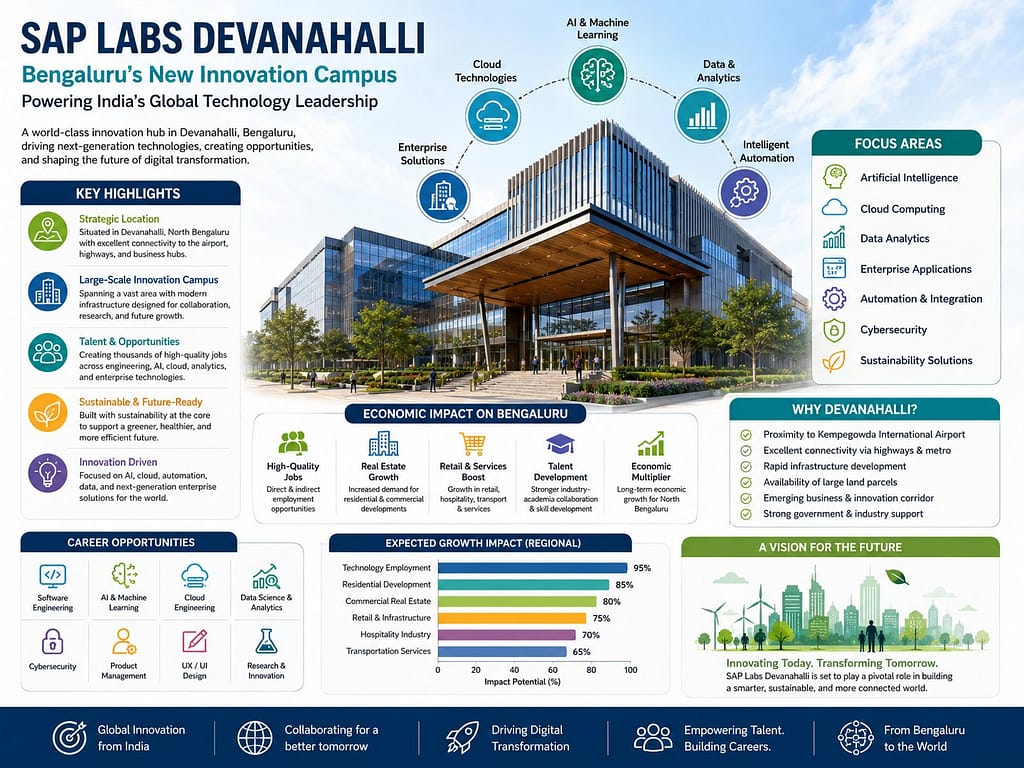
Picture this. You drive north from Bengaluru’s city centre, past the flyovers, past the ring road chaos, and onto the wide, tree-lined highway that leads to Kempegowda International Airport. Just before you reach the terminal, a massive, gleaming campus rises on either side of you — 41 acres of glass, green spaces, innovation labs, and human energy. This is SAP Labs Devanahalli, and it is not just a building. It is a declaration.
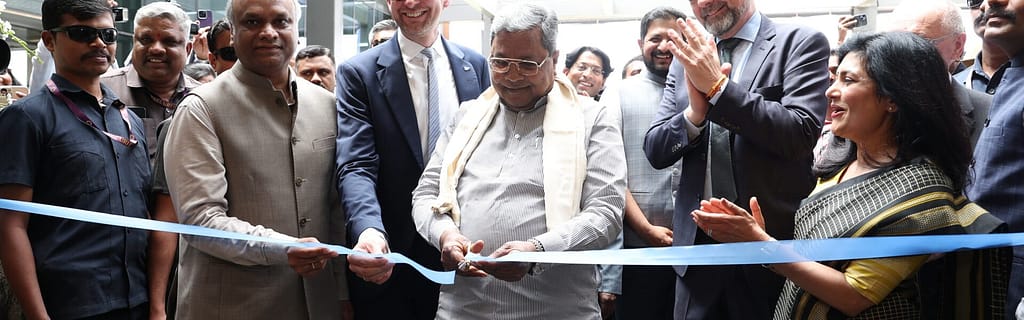
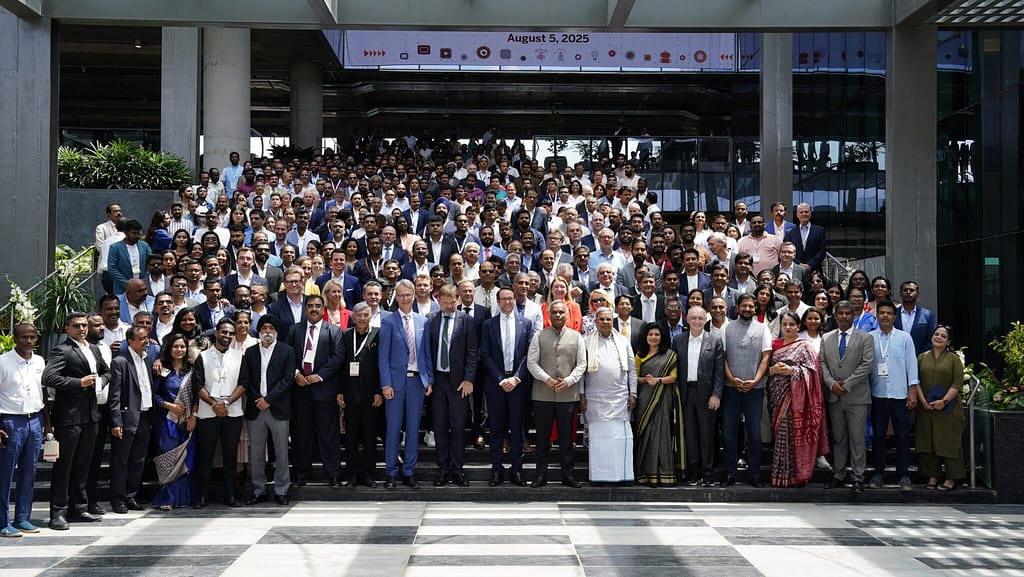
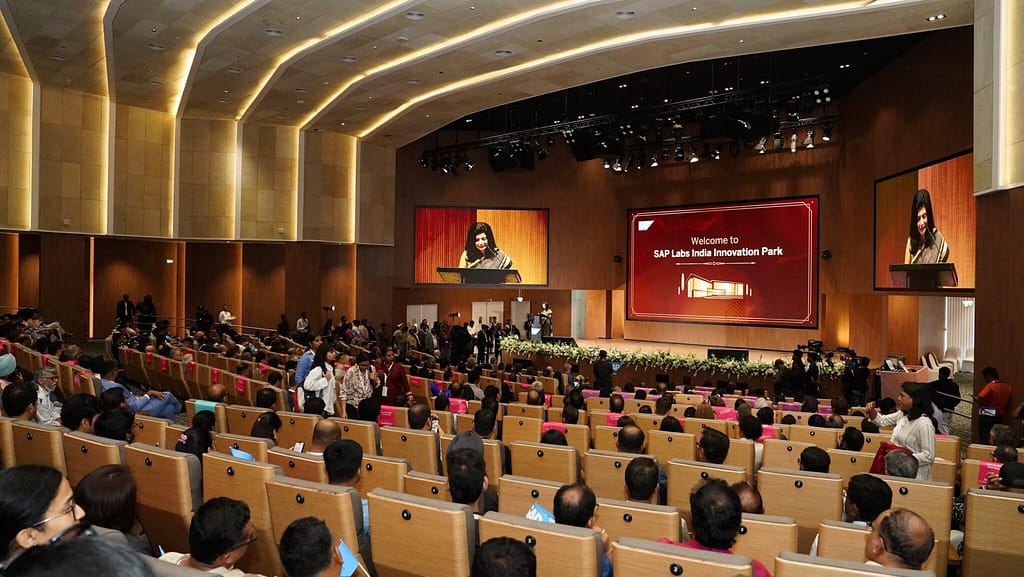
On August 5, 2025, SAP officially inaugurated its second Bengaluru campus — the SAP Labs India Innovation Park — in Devanahalli, North Bengaluru. The event brought together some of the most influential names in technology and government: Karnataka Chief Minister S. Siddaramaiah, Union IT Minister Ashwini Vaishnaw, Karnataka IT Minister Priyank Kharge, the German Ambassador to India Dr. Philipp Ackermann, and SAP’s own executive leadership including Thomas Saueressig and Sindhu Gangadharan, Managing Director of SAP Labs India.
The numbers alone make heads turn. A €194 million (approximately $224 million or ₹1,964 crore) investment. A 41-acre campus. Space for more than 15,000 professionals. Already operational with over 3,200 employees in Phase 1 — with that headcount expected to cross 4,500 within months.
But the real story here is not about square footage or headcount. It is about what SAP Labs Devanahalli signals — for the future of India’s technology ecosystem, for the transformation of North Bengaluru as a global business hub, and for thousands of professionals, researchers, students, and investors who now have a new reason to look north.
This article gives you the complete picture — from the campus features and sustainability design to real estate implications, infrastructure growth, talent programs, and what this means for SAP Devanahalli as the city’s next major tech corridor.

A Quick Snapshot: Key Facts at a Glance
| Parameter | Details |
|---|---|
| Campus Name | SAP Labs India Innovation Park |
| Location | Devanahalli, North Bengaluru |
| Total Area | 41 Acres |
| Total Investment | ₹1,964 Crore (~$224 Million / €194 Million) |
| Current Employees (Phase 1) | 3,200+ |
| Projected Headcount (Near-term) | 4,500+ |
| Full Capacity | 15,000+ Professionals |
| Full Capacity Target Year | 2028 |
| Campus Rank | Second-largest SAP facility in the world |
| Inauguration Date | August 5, 2025 |
| Primary Focus Areas | AI Research, Cloud Engineering, Customer Support, Product Development |
Section 1: Why Devanahalli? The Strategic Logic Behind the Location
When SAP’s leadership chose the location for their second Bengaluru campus, they did not make that decision lightly. SAP Devanahalli sits in one of the most strategically positioned locations in Karnataka — and here is exactly why that matters.
1.1 Proximity to Kempegowda International Airport
The SAP Labs Devanahalli campus is just a few kilometres from Bengaluru International Airport. For a company that works with enterprise clients across Europe, the Americas, and Asia-Pacific, this is a decisive advantage. Business travellers, visiting executives, global teams, and technology partners can step off a flight and walk into a world-class innovation facility within minutes. No long commutes. No navigating the city’s infamous traffic. Just direct access to a global innovation hub.
This proximity also makes the campus a natural choice for hosting client delegations, product showcases, and global summits — turning the Innovation Park into a gateway between India’s tech talent and the world’s enterprise needs.
1.2 The North Bengaluru Transformation Story
Fifteen years ago, Devanahalli was a quiet town 40 kilometres north of Bengaluru, known primarily for its historical fort and the surrounding agricultural land. Then the international airport arrived, and everything changed.
Today, SAP Devanahalli sits at the epicentre of one of India’s fastest-transforming urban corridors. The region now attracts multinational corporations, logistics hubs, aerospace companies, IT parks, and premium residential developments. Land prices have multiplied. Infrastructure spending has surged. And the arrival of SAP Labs Devanahalli accelerates this transformation dramatically.
Think of it this way: what Whitefield was to East Bengaluru in the early 2000s, Devanahalli is to North Bengaluru today. Except this time, the growth has better planning, better infrastructure, and anchored by major global players right from the start.
1.3 Government Backing and Policy Tailwinds
The inauguration itself told a clear story about government alignment. When a state’s Chief Minister, the Union IT Minister, and a foreign nation’s Ambassador all share the same stage for a corporate campus opening, it signals strong institutional support. The Karnataka government has actively positioned North Bengaluru as a priority investment corridor, and SAP Labs Devanahalli fits squarely within that strategy.
Section 2: What Makes the Campus Extraordinary — Inside the Innovation Park
SAP Labs Devanahalli is not a conventional corporate campus. Every design decision reflects a deliberate philosophy: that innovation thrives in environments built around collaboration, well-being, inclusivity, and sustainability. Here is a detailed look at what the campus houses.
2.1 AI Research Labs and Startup Incubation Centres
At the heart of the SAP Labs Devanahalli campus are dedicated AI research labs where engineers and data scientists build the next generation of enterprise artificial intelligence. These are not showcase spaces — they are working research environments where teams tackle real problems in supply chain intelligence, financial automation, human capital analytics, and industry-specific AI applications.
Alongside these labs, startup incubation centres give early-stage companies access to SAP’s technology stack, mentorship networks, and enterprise customer connections. This positions SAP Devanahalli as not just a corporate facility but a broader innovation ecosystem.
2.2 The SAP Experience Center — India’s Second Location
The campus hosts India’s second SAP Experience Center, where enterprise customers can engage with live, fully functional business scenarios powered by SAP’s latest technology. From real-time supply chain simulations to AI-powered financial forecasting dashboards, the Experience Center lets clients see — not just hear about — what SAP technology does in practice.
This is a significant differentiator. Most technology companies describe their capabilities in presentations. SAP Devanahalli lets customers experience those capabilities in a purpose-built, immersive environment.
2.3 The S.Market — AI-Powered Micro-Market
One of the most talked-about features inside the campus is the fully autonomous S.Market — an AI-powered micro-market that operates without traditional checkout counters or cashiers. Using computer vision, sensor fusion, and SAP’s own retail technology, the S.Market lets employees pick up products and walk out, with automated billing handling the transaction.
This is not a gimmick. It is a live demonstration of SAP’s retail and commerce solutions — a working proof-of-concept that the company’s enterprise software can power the future of retail, running in real-time inside their own campus.
2.4 Hybrid Collaboration Spaces and Hackathon Arenas
The SAP Labs Devanahalli campus architects designed spaces explicitly for cross-functional collaboration. Large, reconfigurable collaboration zones allow teams of 10 or 200 to work together without the constraints of traditional office layouts. Dedicated hackathon arenas host internal competitions, partner events, and academic challenges — fostering the kind of intensive, deadline-driven creativity that produces breakthrough ideas.
2.5 Training and Academic Collaboration Zones
The campus includes dedicated facilities for academic partnerships, training programs, and research collaborations. These zones host everything from student internships to joint research projects with institutions like IIT Madras, Gati Shakti Vishwavidyalaya, and the Technical University of Munich.
Section 3: Sustainability — Building the Greenest Campus in SAP’s Global Network
SAP did not just build a large campus at Devanahalli. They built a sustainable one. The SAP Labs Devanahalli Innovation Park integrates environmental responsibility into its physical design, energy systems, and daily operations.
3.1 The 2.5-Acre Eco-Pond and Rainwater Harvesting
The campus features a 2.5-acre eco-pond specifically designed for rainwater harvesting. In a city that has faced increasing water stress due to rapid urbanisation, this is both an environmental statement and a practical solution. The pond collects and stores rainwater, reducing the campus’s dependence on municipal water supply and recharging the local groundwater table.
3.2 Solar Infrastructure
The campus draws a significant portion of its energy from solar installations, reducing both its carbon footprint and long-term operational costs. As SAP moves toward its global sustainability commitments, the SAP Devanahalli campus serves as a model for how technology companies can power large-scale operations with renewable energy.
3.3 Smart Waste Management
The Innovation Park uses smart waste management systems that track, segregate, and process waste streams more efficiently than conventional facilities. From composting organic waste generated by the campus’s food services to managing electronic waste responsibly, the approach reflects a whole-campus commitment to circular resource use.
Campus Sustainability at a Glance
| Sustainability Feature | Details |
|---|---|
| Eco-Pond | 2.5 acres, designed for rainwater harvesting |
| Energy Source | Solar infrastructure across the campus |
| Waste Management | Smart, automated waste segregation and processing |
| Green Design | Integrated into campus architecture from the ground up |
| Water Strategy | Reduced municipal dependence, groundwater recharge |
Section 4: Inclusivity — A Campus Built for Every Professional
The inclusivity features at SAP Labs Devanahalli deserve their own section. SAP designed this campus with a serious commitment to making every professional feel seen, supported, and empowered.
- Tactile Pathways: Textured ground surfaces guide visually impaired employees and visitors safely across the campus.
- Braille Signage: Every key location on campus has Braille signage — not just in a few selected areas but comprehensively throughout the facility.
- Auditory Cues: Audio-based navigation and alerts support professionals with visual impairments during daily movement across the campus.
- Gender-Neutral Restrooms: The campus provides gender-neutral restrooms throughout, reflecting a commitment to dignity and belonging for all employees.
- Sensory Rooms: Dedicated sensory rooms offer a calm, low-stimulation environment for professionals who need a break from the busy campus environment — particularly valuable for neurodivergent employees.
- Nap Pods: Recognising that rest drives performance, the campus includes nap pods where employees can take restorative breaks during long workdays.
These are not token gestures. They represent a coherent philosophy: that a 15,000-person innovation hub works best when every one of those 15,000 people can bring their full selves to work.
Section 5: Talent, Research, and the Future Workforce
SAP Labs Devanahalli does not operate in isolation. It anchors a growing network of talent pipelines, research partnerships, and academic collaborations designed to shape the next generation of enterprise technology professionals.
5.1 The AI Career Accelerator with EduBridge
At the inauguration, SAP announced a landmark partnership with EduBridge to launch the AI Career Accelerator program. The program targets more than 400 students from underserved communities, training them specifically for AI roles in enterprise technology. This is not a generic coding bootcamp. It connects participants directly with SAP’s technology ecosystem, giving them a pathway to meaningful careers in one of the world’s leading technology companies.
5.2 Academic Research Partnerships
SAP’s academic collaborations at SAP Labs Devanahalli cover three cutting-edge research domains:
Quantum Computing — in partnership with the Technical University of Munich, researchers work on quantum algorithms relevant to enterprise optimisation problems.
Health Tech — collaborating with Gati Shakti Vishwavidyalaya, the research explores how SAP technologies can improve healthcare delivery systems.
Physical AI and Brain Research — in collaboration with IIT Madras, a pioneering joint initiative applies AI to brain research, pushing the boundaries of what enterprise AI can learn from neuroscience.
5.3 SAP Labs India’s Global Footprint
SAP Devanahalli joins a broader story of India’s centrality to SAP’s global operations. Today, SAP employs more than 17,000 people across India. These professionals drive product engineering, customer services, cloud delivery, and applied research. India now operates as SAP’s largest R&D hub outside Germany — and the SAP Labs Devanahalli campus dramatically expands that capability.
Workforce Growth Projection
| Phase | Employee Count | Timeline |
|---|---|---|
| Phase 1 (Current) | 3,200+ | August 2025 |
| Near-Term Target | 4,500+ | By End of 2025 |
| Mid-Term Expansion | ~8,000–10,000 | 2026–2027 |
| Full Capacity | 15,000+ | 2028 |
Section 6: The Real Estate and Economic Impact of SAP Labs Devanahalli
The arrival of SAP Labs Devanahalli does not just change the technology landscape — it reshapes the real estate and economic geography of North Bengaluru in measurable ways.
6.1 Property Values in the Devanahalli Corridor
Real estate markets respond immediately to anchor investments of this scale. The SAP Devanahalli campus joins a growing list of major employers and institutions establishing themselves in North Bengaluru — and the property data reflects that momentum.
Current Real Estate Pricing in Devanahalli
| Property Category | Current Price Range (₹ per sq ft) | Annual Appreciation Rate |
|---|---|---|
| Apartments | ₹7,800 – ₹9,300 | ~9% |
| Residential Plots | ₹4,200 – ₹5,500 | 12% – 18% |
| Premium Plots | ₹5,400 – ₹6,900 | ~20.4% |
| Residential Apartments | ₹4,500 – ₹7,500 | 8% – 12% |
| Commercial Properties | ₹8,000 – ₹10,000 | 8% – 12% |
| Overall Average Rate | ~₹10,000 per sq ft | 10% – 15% |
6.2 The Devanahalli Business Park
Beyond the SAP Labs Devanahalli campus, the broader Devanahalli Business Park — a planned 400-acre financial and commercial district — will host multinational corporations, IT parks, premium office spaces, and hospitality developments. SAP Devanahalli effectively anchors the technology tenant base of this larger ecosystem.
Grade A commercial and co-working spaces already attract startups and established firms. Analysts project property values in comparable smart city zones will appreciate by up to 20% over the next five years. Rental yields for quality commercial spaces are on a trajectory of 8–12% annual growth.
6.3 Job Creation and Economic Multiplier Effect
A campus housing 15,000 professionals does not create 15,000 jobs — it creates far more. Every direct hire at SAP Labs Devanahalli generates demand for housing, transportation, food services, retail, childcare, healthcare, and entertainment. Economists typically estimate a multiplier of 3–5 indirect jobs for every direct technology sector job. At full capacity, this campus could support 45,000–75,000 total livelihoods in the surrounding region.
Section 7: Infrastructure Accelerators — Metro, Rail, and Road Connectivity
The strategic value of SAP Devanahalli grows even stronger when you factor in the infrastructure investments currently underway in North Bengaluru.
7.1 Namma Metro Blue Line — Airport Connectivity
The long-awaited Blue Line of Namma Metro will connect Kempegowda International Airport to Hebbal and further into central Bengaluru. Despite construction challenges, the project continues at pace and is expected to reach completion by early 2027. Two dedicated airport metro stations — one at the City side and one at the Terminal — will put SAP Labs Devanahalli within easy reach of the entire metro network.
For the thousands of employees who commute daily to SAP Devanahalli, metro connectivity transforms the calculus entirely — cutting commute times, reducing road congestion, and making the campus accessible from a far wider catchment area.
7.2 Bengaluru Suburban Rail — The Sampige Line
The Sampige Line under the Bengaluru Suburban Rail Project will directly link KSR Bengaluru City Station to Devanahalli and the Airport. Expected to become operational by June 2029, this suburban rail connection will fundamentally change last-mile access to the SAP Labs Devanahalli corridor — supporting daily commuters, reducing private vehicle dependency, and promoting distributed residential development along the rail corridor.
7.3 STRR (Satellite Town Ring Road)
The Satellite Town Ring Road further enhances road connectivity to Devanahalli, linking it directly to other key employment and residential zones around Bengaluru. For employees driving to SAP Devanahalli from Whitefield, Electronic City, or Mysore Road, the STRR cuts travel time substantially.
Infrastructure Timeline
| Project | Expected Completion | Impact on SAP Devanahalli |
|---|---|---|
| Namma Metro Blue Line (Airport) | Early 2027 | Direct metro access from city centre |
| Bengaluru Suburban Rail (Sampige Line) | June 2029 | Rail connectivity to KSR Bengaluru |
| STRR Road Connectivity | Ongoing | Faster cross-city road access |
| Devanahalli Business Park Development | 2026–2030 | 400-acre commercial district surrounding the campus |
Section 8: Comparing the Two SAP Campuses in Bengaluru
One of the most frequently asked questions in the tech community is how SAP Labs Devanahalli compares to the original Whitefield campus. Here is a direct comparison.
| Parameter | Whitefield Campus | SAP Labs Devanahalli Innovation Park |
|---|---|---|
| Location | East Bengaluru (Whitefield) | North Bengaluru (Devanahalli) |
| Campus Size | ~20 Acres | 41 Acres |
| Capacity | ~7,000–8,000 Employees | 15,000+ Employees |
| Primary Focus | Product Engineering, Enterprise Software | AI, Cloud, Customer Innovation, R&D |
| Year Established | 1998 (27-year legacy) | 2025 (Inaugurated August 5) |
| Investment Scale | Original founding investment | ₹1,964 Crore (€194 Million) |
| Airport Proximity | ~40–50 km | ~5 km |
| Metro Connectivity | Existing Purple Line access | Blue Line (Coming 2027) |
| SAP Experience Center | No | Yes (India’s second location) |
| AI Research Lab | Partial capability | Full dedicated labs |
| Sustainability Features | Standard | Advanced (eco-pond, solar, smart waste) |
Section 9: What This Means for Tech Professionals and Job Seekers
If you work in enterprise technology — or aspire to — SAP Labs Devanahalli reshapes your career landscape.
Roles the Campus Will Hire
The Innovation Park’s focus areas translate directly into high-demand roles:
- AI/ML Engineers and Research Scientists
- Cloud Architecture and Platform Engineers
- Enterprise Application Developers (SAP S/4HANA, BTP, RISE)
- Customer Success and Solution Consulting Professionals
- Data Engineers and Analytics Specialists
- UX Researchers and Product Designers
- Quantum Computing Researchers (in partnership with TU Munich)
- DevOps and Site Reliability Engineers
Why SAP Labs Devanahalli Stands Out as an Employer
SAP Devanahalli offers something rare: the scale of a global tech giant combined with the energy of a new, purpose-built innovation environment. Professionals who join in the early years of the campus benefit from greater responsibility, faster growth trajectories, and the experience of building something from the ground up.
The campus’s academic partnerships — particularly the IIT Madras collaboration on AI-based brain research — also give technically ambitious employees access to research opportunities that go well beyond conventional corporate work.
Section 10: The Broader Vision — India as SAP’s Global Innovation Epicentre
SAP has operated in India for 27 years. But SAP Labs Devanahalli represents a qualitative shift — not just a larger headcount or a bigger building, but a fundamental repositioning of India’s role in SAP’s global strategy.
Sindhu Gangadharan, Managing Director of SAP Labs India, said it directly at the inauguration: the Innovation Park stands as “a physical manifestation of our belief in India’s role as a global innovation epicentre.”
Thomas Saueressig, SAP Executive Board Member, reinforced this: “It is a global innovation hub that will help our customers move from insight to action with enterprise-grade AI, data, and applications created right here in India.”
This language matters. SAP is not treating India as an offshore execution centre. SAP Devanahalli houses teams that build, engineer, and innovate at the frontier of enterprise technology. The AI solutions, cloud architectures, and industry applications that SAP sells to Fortune 500 companies around the world increasingly originate from the 17,000+ professionals who work in India.
The SAP Labs Devanahalli campus gives that story a physical home — a campus worthy of the ambition.
Looking to Build a Career in SAP? Start with Industry-Focused SAP Training
As global companies like SAP continue expanding their innovation centers in Bengaluru, the demand for skilled SAP professionals keeps rising across industries. Organizations need experts who understand enterprise processes, cloud ERP systems, SAP S/4HANA, analytics, finance, procurement, logistics, and digital transformation.
For students, fresh graduates, accountants, finance professionals, and IT professionals, this creates a significant opportunity to build a future-proof career in enterprise technology.
At ERP Class, learners gain practical exposure through real-time projects, hands-on ERP system access, industry-oriented training, and certification guidance. Whether you want to specialize in SAP FICO, SAP MM, SAP SD, SAP ABAP, SAP HANA, or SAP S/4HANA, choosing the right training institute plays a major role in your career growth.
Section 11: SAP Labs Devanahalli vs. Global Tech Campuses — How It Compares
| Campus | Company | Location | Size | Capacity |
|---|---|---|---|---|
| SAP Labs India Innovation Park | SAP | Devanahalli, Bengaluru | 41 Acres | 15,000+ |
| SAP Walldorf HQ | SAP | Walldorf, Germany | ~200 Acres | 23,000+ |
| Google India HQ | Hyderabad | ~12 Acres | 10,000+ | |
| Microsoft India Campus | Microsoft | Hyderabad | ~40 Acres | 10,000+ |
| Infosys Global Education Centre | Infosys | Mysuru | 337 Acres | 15,000 (Training) |
| Wipro Sarjapur Campus | Wipro | Bengaluru | ~70 Acres | 20,000+ |
Among new-generation enterprise tech campuses globally, SAP Labs Devanahalli ranks among the largest purpose-built innovation parks outside a corporate headquarters.
Section 12: Investment Outlook — Should You Invest Near SAP Labs Devanahalli?
For real estate investors and homebuyers tracking North Bengaluru, SAP Devanahalli fundamentally changes the investment thesis for the region.
The Bull Case
Demand surge from direct employment: 15,000 highly-paid technology professionals need housing within a reasonable commute of SAP Labs Devanahalli. Residential demand in Devanahalli, Doddaballapur Road, Yelahanka, and the NH-44 corridor will grow significantly as the campus scales toward full capacity.
Commercial real estate premium: Retail, food and beverage, co-working spaces, healthcare clinics, gyms, and entertainment venues that serve the campus community will all benefit from proximity to SAP Devanahalli.
Infrastructure appreciation: The combined impact of the Metro Blue Line, Suburban Rail, STRR, and the Devanahalli Business Park creates multiple independent tailwinds for property appreciation — independent of SAP’s growth alone.
Plot appreciation rate: Premium plots in the Devanahalli corridor already show annual appreciation of approximately 20.4% — the highest of any residential asset class in the area. That trajectory accelerates as SAP Labs Devanahalli reaches its full workforce.
Key Risks to Consider
Like any investment thesis, the SAP Devanahalli story carries risks. Infrastructure timelines — particularly the Metro Blue Line and Suburban Rail — have historically faced delays in Bengaluru. Investors should price in those risks rather than relying on officially announced timelines. Additionally, commercial property supply in the area may increase faster than demand in the short term, compressing rental yields temporarily before stabilising.
A Note on SAP’s 27-Year India Journey
The SAP Labs Devanahalli campus does not emerge from nowhere. It builds on 27 years of SAP’s presence in India, starting with the founding of SAP Labs India in 1998. What began as a small software development centre in Bengaluru has grown into a network of over 17,000 professionals working across product development, customer services, cloud delivery, and frontier research.
Every phase of that journey has expanded India’s role in SAP’s global story — from localising software for Indian markets to building global products, from supporting international clients to leading innovation in AI and enterprise cloud. SAP Labs Devanahalli is the latest chapter in that journey, and by every measure, it is the most ambitious one yet.
Frequently Asked Questions (FAQ)
Q1. Where exactly is SAP Labs Devanahalli located? SAP Labs Devanahalli — officially named the SAP Labs India Innovation Park — sits near the Kempegowda International Airport in Devanahalli, North Bengaluru, approximately 40 kilometres from the city centre.
Q2. How large is the SAP Labs Devanahalli campus? The campus covers 41 acres, making it nearly double the size of SAP’s original Whitefield campus in Bengaluru. At full operational capacity, SAP Labs Devanahalli will house more than 15,000 professionals.
Q3. How much did SAP invest in the Devanahalli campus? SAP invested approximately €194 million (around $224 million or ₹1,964 crore) to build the SAP Labs Devanahalli Innovation Park.
Q4. When did SAP Labs Devanahalli open? The campus officially inaugurated on August 5, 2025, in the presence of Karnataka Chief Minister S. Siddaramaiah, Union IT Minister Ashwini Vaishnaw, and SAP Executive Board Member Thomas Saueressig, among others.
Q5. How many employees currently work at SAP Labs Devanahalli? Phase 1 of SAP Labs Devanahalli is already operational with over 3,200 employees. That number is expected to grow to 4,500+ within months, with full capacity of 15,000+ professionals targeted by 2028.
Q6. What does SAP do at the Devanahalli campus? SAP Devanahalli focuses on artificial intelligence research, cloud platform engineering, product development, customer innovation services, and enterprise application design. It also houses an SAP Experience Center and the autonomous AI-powered S.Market.
Q7. Is SAP Labs Devanahalli hiring? Yes. As SAP Labs Devanahalli scales toward full capacity, it actively hires across AI/ML engineering, cloud architecture, SAP product development, data engineering, UX design, quantum computing research, and customer success roles.
Q8. How does Metro and rail connectivity affect SAP Devanahalli commuters? The Namma Metro Blue Line, expected by early 2027, will provide direct metro access to SAP Devanahalli from central Bengaluru. The Bengaluru Suburban Rail Sampige Line, expected by June 2029, will add rail connectivity. Both projects dramatically expand the commuter catchment area for the campus.
Q9. What sustainability features does SAP Labs Devanahalli have? The campus includes a 2.5-acre eco-pond for rainwater harvesting, solar energy infrastructure, smart waste management systems, tactile pathways, Braille signage, gender-neutral restrooms, sensory rooms, and nap pods.
Q10. Does the SAP Labs Devanahalli opening affect property prices in North Bengaluru? Yes. The arrival of SAP Labs Devanahalli adds significant demand pressure to residential and commercial real estate in the Devanahalli corridor. Premium plots in the area already show annual appreciation rates of approximately 20.4%, and the full employment ramp-up to 15,000 professionals will sustain that demand for years.
Q11. What academic collaborations does SAP run from the Devanahalli campus? SAP Labs Devanahalli hosts research collaborations with IIT Madras (AI-based brain research), Gati Shakti Vishwavidyalaya (health tech), and the Technical University of Munich (quantum computing). The campus also runs the AI Career Accelerator with EduBridge, targeting 400+ students from underserved communities.
Q12. How does SAP Labs Devanahalli rank globally among SAP campuses? SAP Devanahalli ranks as the second-largest SAP facility in the world, behind only SAP’s global headquarters in Walldorf, Germany. It also serves as SAP’s largest R&D hub outside Germany.
Conclusion
The launch of SAP Labs Devanahalli represents a landmark moment in Bengaluru’s technology journey.
The campus strengthens SAP’s commitment to India, supports future innovation, creates employment opportunities, encourages startup collaboration, and contributes to regional economic development.
As artificial intelligence, cloud computing, enterprise software, and digital transformation continue reshaping global business, SAP Labs Devanahalli stands positioned to play a crucial role in defining the next generation of enterprise technology.
The investment reflects confidence in India’s talent, Bengaluru’s innovation ecosystem, and the future of technology-led growth.
For professionals, students, entrepreneurs, and businesses, the rise of SAP Devanahalli signals exciting opportunities ahead.